

Updated:
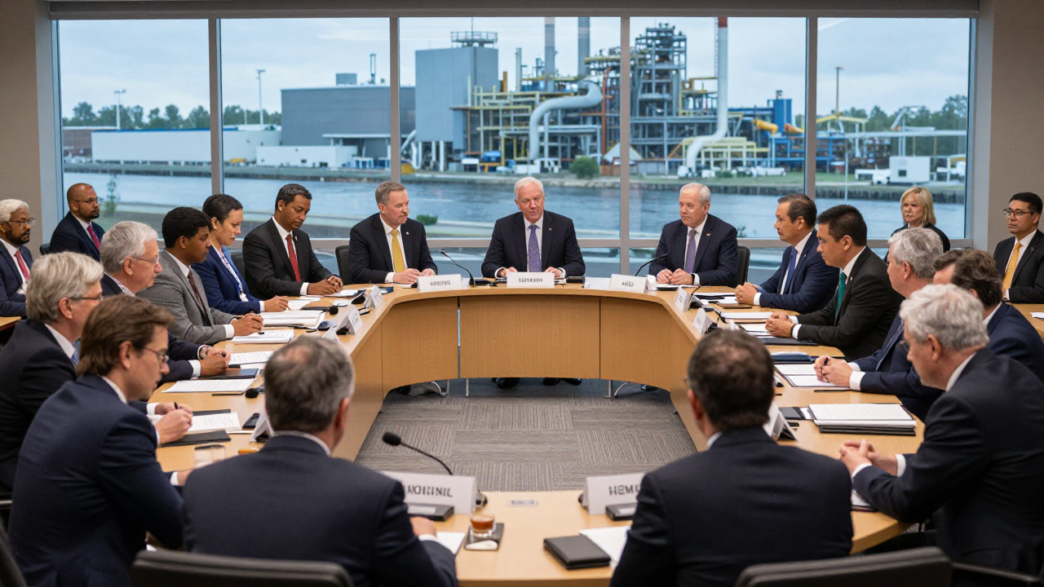
G20 trade ministers meeting in Milwaukee failed to agree on a U.S.-backed approach to excess industrial capacity, exposing divisions over how to respond to goods produced in quantities that exceed demand. The U.S. Trade Representative’s office said Friday, October 2, that a “handful” of ministers rejected a proposed pathway for cooperation, but did not identify the countries that objected.
The dispute leaves Washington without a unified G20 endorsement of its effort to address production it considers market-distorting, including through subsidies and other policies. The meeting did produce agreement on a separate issue: members said food and agricultural trade should not be used as a tool of economic or political coercion. Reuters reported that only Mexico and Argentina backed a U.S.-led statement seeking further cooperation to eliminate goods made with forced labor from supply chains.
U.S. says most ministers backed further work
The U.S. chair’s statement said the draft on excess capacity was supported by all but a handful of members, including a few that “firmly rejected” creating a cooperative pathway. It described the opposition as a significant disappointment to the U.S. G20 presidency. The statement did not set out a list of supporters or opponents, leaving the precise balance of views unclear.
The disagreement followed a trade ministers’ meeting that ended in Milwaukee on Thursday, October 1. U.S. Trade Representative Jamieson Greer characterized the discussions as constructive, despite the lack of consensus. The Associated Press reported that Greer said nearly all countries agreed excess capacity was an issue requiring action and that existing trade remedies were inadequate, but that a number of difficult issues remained.
China dispute shapes the debate
China’s industrial output and subsidies have been central themes at U.S.-led G20 ministerial meetings this year. Beijing has rejected claims that its industrial policies create excess capacity and has accused Western governments of using the issue to justify protectionist measures. Although the U.S. statement did not name the countries that opposed its proposal, Reuters noted that China objected to a similar statement at a G20 finance leaders’ meeting in Asheville, North Carolina, a month earlier.
The U.S. administration argues that surplus production can send underpriced goods into overseas markets and undermine manufacturers in other countries. In Milwaukee, the Associated Press reported, U.S. officials cited sectors including steel, autos, batteries, paper and semiconductors as areas affected by what Washington describes as overproduction. The administration has also opened investigations into production capacity across multiple economies; the existence of those probes does not itself establish that any country has violated trade rules.
Other trade initiatives yield different results
The split over a broad approach to excess capacity came alongside a more focused steel initiative. Axios reported that G20 trade officials announced the Milwaukee Framework, which calls for curbing market-distorting subsidies, monitoring steel imports and trade circumvention, and taking evidence-based action against excess capacity. The framework’s support for possible tariffs is specific to that initiative; it does not amount to a G20-wide agreement on the broader U.S. proposal.
The ministers also discussed forced labor in supply chains, where support was narrower. According to the U.S. statement reported by Reuters, Mexico and Argentina were the only countries to sign the U.S.-led statement calling for more work and cooperation to eliminate goods produced with forced labor. The Trump administration has imposed tariffs on imports from countries it says inadequately enforce forced-labor bans, adding a contentious enforcement issue to the trade talks.
Agreement on food trade, but no broad consensus
On food and agriculture, the U.S. said ministers reached consensus that trade in those products should not be used for economic or political coercion. That agreement contrasts with the divisions over industrial production and forced labor, and shows that the meeting produced statements on some discrete issues without resolving the more contentious questions around subsidies, surplus output and trade remedies.
No list of the countries that rejected the excess-capacity proposal, revised text, or timetable for further negotiations was included in the U.S. statement described by Reuters. The available reporting also does not establish whether the Milwaukee discussions will lead to a new formal G20 commitment. For now, the outcome is a documented divide: the U.S. says most members were willing to continue work on excess capacity, but a small group opposed turning that discussion into a cooperative G20 pathway.