

Updated:
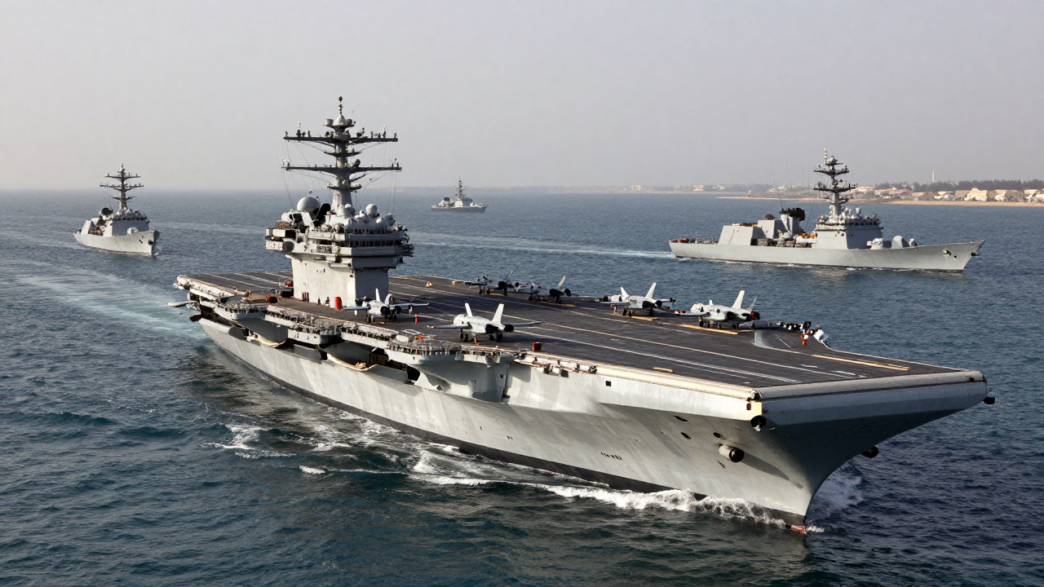
The United States is sending the USS Theodore Roosevelt carrier strike group and thousands of additional sailors and Marines toward the Middle East as the Trump administration increases military and economic pressure on Iran. The deployment comes as the conflict remains unresolved, diplomatic efforts are stalled and President Donald Trump has said expanded strikes remain possible.
Bloomberg, in reporting carried by Investing.com on October 3, said the force could bring three U.S. carrier strike groups to the region, though one of the carriers already there may leave. The Associated Press separately reported that roughly 9,000 personnel are aboard the ships heading to the Middle East, including the Roosevelt strike group and an amphibious readiness group. The force’s arrival could bring the U.S. naval presence to more than 20,000 sailors and Marines, according to the AP.
The buildup coincides with a sharp squeeze on Iran’s oil exports and a recovery in shipments from other Gulf producers. Those changes matter beyond the battlefield: the Strait of Hormuz is a key energy route, and Tehran’s ability to disrupt regional flows is being tested even as its own crude exports face a U.S. blockade.
Carrier deployment expands U.S. options
The ships headed to the region include the Theodore Roosevelt carrier strike group and the USS Makin Island amphibious readiness group, the AP reported. The latter includes the USS John P. Murtha and USS Anchorage. Their deployment adds to U.S. naval forces already operating in the area.
Three carrier strike groups would represent an unusually large concentration of U.S. naval power in the Middle East. The AP reported that the Navy last had three carrier groups there in April, the first such deployment since 2003. The current movement is expected to bring the additional ships into the region toward the end of October, according to a U.S. official cited by the AP.
Trump has linked the military posture to the possibility of renewed attacks. In a Time magazine interview published October 1, he said stepped-up bombing after the November 3 U.S. elections was possible, while declining to describe his strategy. The AP reported that he also rejected a recent Iranian ceasefire proposal, saying an offer involving the opening of the Strait of Hormuz was not sufficient.
Iran’s oil trade faces added strain
Bloomberg’s report said a U.S. blockade has sharply reduced Iran’s crude exports. Preliminary estimates showed no Iranian crude loaded onto tankers in September, although some Chinese refiners continued to receive oil from floating storage. The figures are preliminary and do not establish that all Iranian oil shipments have stopped.
Iran has shifted more trade through land borders and the Caspian Sea, Bloomberg reported, but those routes cannot fully replace the capacity of Persian Gulf shipping. The report also described mounting domestic economic pressure: inflation was approaching 90%, while the rial had fallen about 25% against the U.S. dollar over two months and nearly half its value over the year.
Washington added sanctions on Iranian automakers and rail companies on October 1, according to the report. The new measures followed earlier actions that disrupted Iranian aviation links, adding economic restrictions to the naval pressure on oil shipments.
Gulf exports recover, but Hormuz control remains contested
Regional oil flows have recovered as Gulf producers increase exports. Saudi crude exports rose to about 6.1 million barrels per day in September, from 3.4 million in August, Bloomberg reported. JPMorgan estimated that Middle East crude shipments had reached 17.5 million barrels per day, or 98% of pre-war levels.
Those figures indicate a substantial recovery in regional supply, but they do not settle how much influence Iran retains over the Strait of Hormuz. Bloomberg cited differing assessments from regional defense officials: one said Tehran still had significant influence, while another judged its grip to be weakening. The available reporting does not establish that Iran has lost the ability to threaten shipping.
The U.S. deployment adds military capacity while oil exports from other Gulf states improve. However, the reported data describe current shipments and estimates, not a guarantee that trade will remain uninterrupted or that the blockade will prevent all Iranian oil from reaching buyers.
Negotiations remain unresolved
Diplomatic efforts remained deadlocked in the reporting available on October 3. Iranian Foreign Minister Abbas Araghchi had suggested restoring access for nuclear inspectors in exchange for sanctions relief, Bloomberg reported, citing diplomats. The report did not indicate that Washington had accepted the proposal or that a new round of negotiations had been scheduled.
Iran was preparing for the possibility of renewed U.S. bombing, according to an Iranian official cited by Bloomberg. The Islamic Revolutionary Guard Corps had warned it would respond to any new U.S. or Israeli attack. Neither the timing nor the terms of any further negotiations or military action had been confirmed in the reports.
The next concrete development will be the arrival of the additional U.S. ships, expected toward late October, while the November 3 U.S. elections mark a date Trump has referenced in discussing possible escalation. Whether the deployment is followed by new strikes, a diplomatic agreement or a change in oil flows remains uncertain.