

Updated:
Boston Dynamics appointed Rohit Prasad, a former Amazon senior vice president who led work on Alexa and artificial general intelligence, as chief executive effective October 7. The move puts an executive with experience developing consumer AI products in charge of the robotics company as its Hyundai Motor Group owner prepares to expand the use and production of robots in manufacturing.
The appointment, announced by Boston Dynamics on October 6, follows the departure of former CEO Robert Playter in February. The company said Prasad would focus on combining AI with robotics and bringing intelligent machines into commercial and industrial settings. It did not disclose financial terms or describe specific changes to its product or investment plans.
From Alexa to robotics leadership
Prasad spent 12 years at Amazon, where he served as senior vice president and head scientist for Alexa and artificial general intelligence. Boston Dynamics said he helped build Alexa from its early development into a service used in hundreds of millions of households, and more recently led development of Amazon’s Nova foundation-model family for enterprise customers.
Before Amazon, he spent nearly 14 years at Raytheon BBN Technologies, leading machine-learning research and its application in government and commercial work, according to Boston Dynamics. The company also highlighted his longstanding professional and academic ties to the Boston-area technology community.
Boston Dynamics framed the hire as part of its “Physical AI” strategy: using AI capabilities in robots that operate in real-world environments. Prasad is expected to join the company’s board of directors, subject to the relevant approval process. In the company’s announcement, Hyundai Motor Group Vice Chair Jaehoon Chang said the combination of the robotics business, Prasad’s product experience and Hyundai’s manufacturing, logistics and mobility capabilities would support efforts to develop and scale that strategy.
Hyundai’s manufacturing ambitions
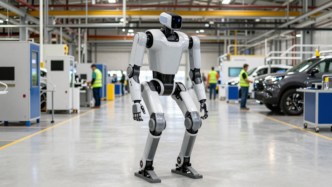
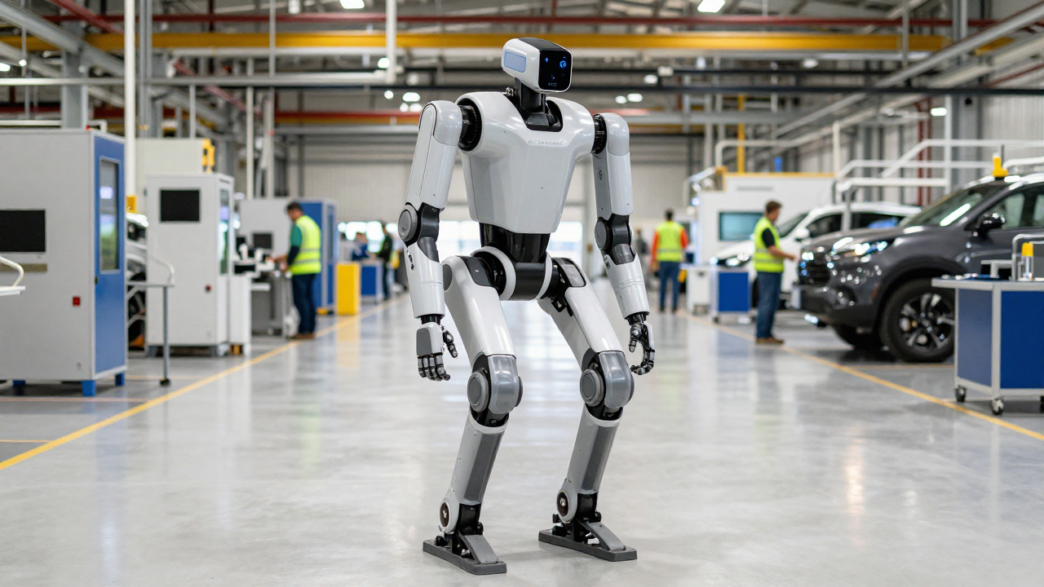
The leadership change comes as Hyundai works to connect Boston Dynamics’ robotics development with its automotive manufacturing network. In January, Hyundai outlined a goal of establishing a production system capable of making 30,000 robots annually by 2028. It has described plans to deploy Atlas humanoid robots within its manufacturing operations, while also expanding commercial use of its existing Spot and Stretch robots.
At CES in January, Boston Dynamics presented Atlas publicly and said a product version was in production, with deployment planned at a Hyundai electric-vehicle facility near Savannah, Georgia, by 2028. The Associated Press reported that Hyundai also announced a partnership with Google DeepMind to supply AI technology for Boston Dynamics robots. The developments indicate that the company’s commercialization effort involves both in-house leadership and external technology partnerships; the appointment announcement did not specify how Prasad’s role would affect those arrangements.
In September, Boston Dynamics opened a robotics training facility inside a Hyundai plant in Georgia, according to Axios. The center is intended to help train Atlas for factory tasks, initially including logistics and parts sequencing. The company has not publicly specified how many robots are operating at the site, Axios reported.
Commercial plans and unanswered questions
Boston Dynamics sells Spot, a quadruped used for industrial inspection and other applications, and Stretch, a robot designed to move boxes in logistics settings. Atlas is a humanoid platform still in development. In January, Hyundai said it intended to pursue broader industrial and commercial markets for Atlas and cited the group’s manufacturing capacity as a route to scaling production.
Those plans face practical and organizational questions that the CEO announcement did not address, including the timing and scale of deployments beyond Hyundai facilities. Axios reported in September that Hyundai workers had protested plans for Atlas deployment, while Boston Dynamics declined to say how many robots were already operating at the Georgia training center. The appointment release did not comment on labor concerns or provide a schedule for broader customer deployments.
For now, the next clear milestones remain the company’s stated target of beginning Atlas deployment at a Hyundai facility by 2028 and Hyundai’s goal of building annual capacity for 30,000 robots by that year. Prasad’s appointment takes effect immediately, while his expected board seat remains subject to approval. The company has not announced additional dates for production expansion or changes to its commercial roadmap.