

Updated:
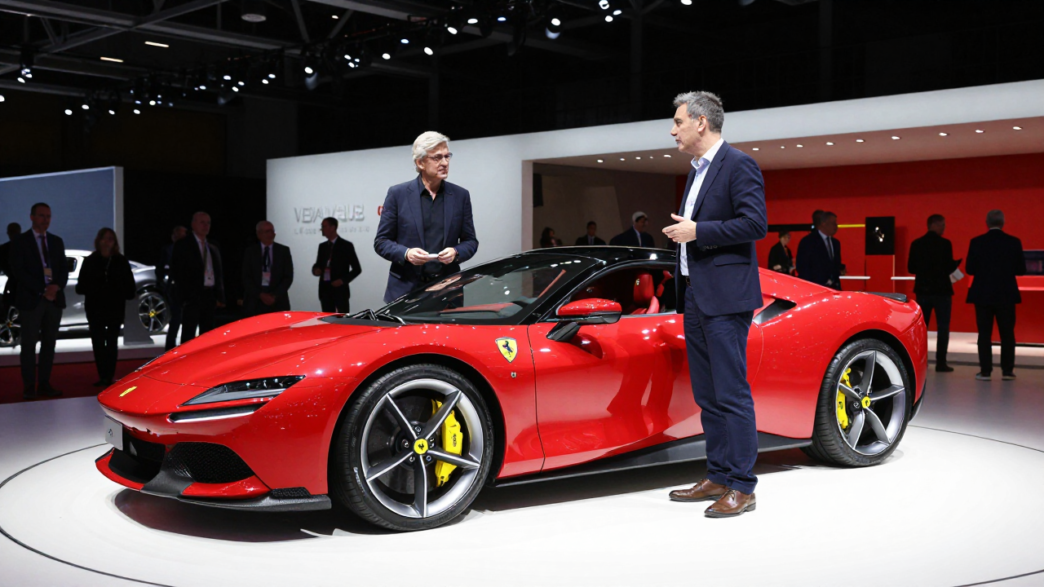
Ferrari chairman John Elkann said a July 2016 conversation with Amazon founder Jeff Bezos prompted him to think seriously about building an electric Ferrari, a decade before the company introduced the Luce, its first fully electric model. Elkann recounted the exchange on Wednesday, October 7, at the Wave technology conference in Turin, Italy, where he appeared with designer Jony Ive.
The project that followed was developed with Ive and his LoveFrom design team and unveiled in May 2026. Its path from an informal conversation to a production car illustrates how Ferrari approached electrification as a question of adapting new technology to the marque, rather than simply replacing an internal-combustion engine with batteries.
The Luce has also drawn criticism for its unconventional styling and debate over Ferrari’s electric-car strategy. Elkann and Ive defended the work at the Turin event, while describing a design process that began with research into the company’s history and placed emphasis on physical controls and tactile interaction.
A conversation that began the discussion
Elkann said the exchange with Bezos took place during a walk in July 2016. Bezos told him he knew little about cars but understood innovation, and urged him to consider seriously building an electric Ferrari, according to Elkann’s account at the conference.
The chairman said the encounter was the first moment he began thinking seriously about what an electric Ferrari might mean. The aim, he said, was not merely to produce an electric car, but to consider what Ferrari could make using emerging technologies.
The account places the beginning of the idea well before the Luce’s public debut, but does not suggest that Bezos was involved in the car’s engineering or design. Rather, Elkann described the conversation as an early prompt for Ferrari to examine the prospect of electrification.
LoveFrom’s research-led design process
Ive said LoveFrom spent close to a year studying Ferrari’s history and culture before moving into vehicle design. Instead of arriving at early meetings with renderings, the team brought books documenting what it had learned, according to Italian newspaper la Repubblica’s account of the conference.
Reuters reported that teams in California and at Ferrari’s Maranello headquarters worked together on the project for five years. The collaboration took shape during the pandemic, when Ive had left Apple and began discussing possible work with Elkann, who said he sought Ive’s advice about how Ferrari should think about future projects.
The process reflected an attempt to understand the brand before deciding what a new electric model should be. Ive said Ferrari’s team continued to engage with LoveFrom’s research materials through several meetings before seeing renderings, an approach that required patience and trust between the design studio and the automaker.
Physical controls over a touchscreen-first approach
One of Ive’s stated design choices was to avoid making a touchscreen the car’s primary interface. He argued at the conference that touch controls can distance drivers from an object, while physical switches and controls offer tactile feedback and can be used without looking away from the road.
The Luce therefore combines digital technology with physical controls, according to Ive. His position marks a notable contrast with his work at Apple, where he helped shape products associated with touch-based interfaces; he framed the car’s controls around the distinct demands of interacting with a vehicle.
The design discussion also extended to how the car signals that it is starting. La Repubblica reported that Ive described a yellow glass key whose color disappears when inserted, transferring its visual effect to the vehicle through an electronic-ink display. Ive presented the sequence as an effort to create a moment of ceremony in an electric car, where the familiar sensory cues of starting an engine are absent.
Debate follows the May unveiling
Ferrari unveiled the Luce in May 2026 as its first fully electric model. Its styling triggered mockery and criticism on social media, Reuters reported, while some investors questioned the company’s bet on electrification. The reports did not provide a quantified measure of the reaction or establish how it has affected orders.
Elkann said Ferrari had not set out to create a controversial car, but that the response strengthened the company’s conviction. He and Ive also argued that viewing the car in person could change perceptions formed from images; a Luce was displayed at the Turin conference, where visitors queued to see it, Reuters reported.
Ive cautioned against dismissing negative reactions simply because a design is new. In remarks reported by la Repubblica, he acknowledged that novelty alone does not make a product better, and said the challenge was to make difference serve the product rather than act as a justification for it.
What is known about the next stage
Ferrari’s annual report says the Luce’s full world premiere took place in Rome on May 25, 2026, following earlier presentations of its technical components and interior. Ferrari had previously said deliveries would begin in late 2026, while its February 2026 results release described the May event as the final stage of the reveal.
The statements at Wave by Vento added context about the idea’s origins and the design partnership, but did not announce a change to launch timing, production plans or commercial targets. The conference remarks likewise offered no new delivery figures or assessment of demand, leaving those questions outside the scope of the disclosures made in Turin.