


Updated:
U.S. stocks climbed to record levels on Tuesday, October 6, as technology and artificial-intelligence shares rallied and a pause in the bond-market sell-off eased pressure on equities. The S&P 500 rose as much as 0.6%, briefly moving above its previous intraday record, while the Nasdaq also reached a fresh high. Investors were looking ahead to the start of the third-quarter earnings season.
The advance came alongside signs of strain elsewhere in the global economy. U.S. imports hit a record in August, widening the trade deficit to its largest level in 17 months, while government bond yields remained a focus for investors assessing borrowing costs and the Federal Reserve’s next steps. The mix of buoyant share prices and economic uncertainty made Treasury auctions and upcoming policy signals important tests for the rally.
AI shares drive the record-setting session
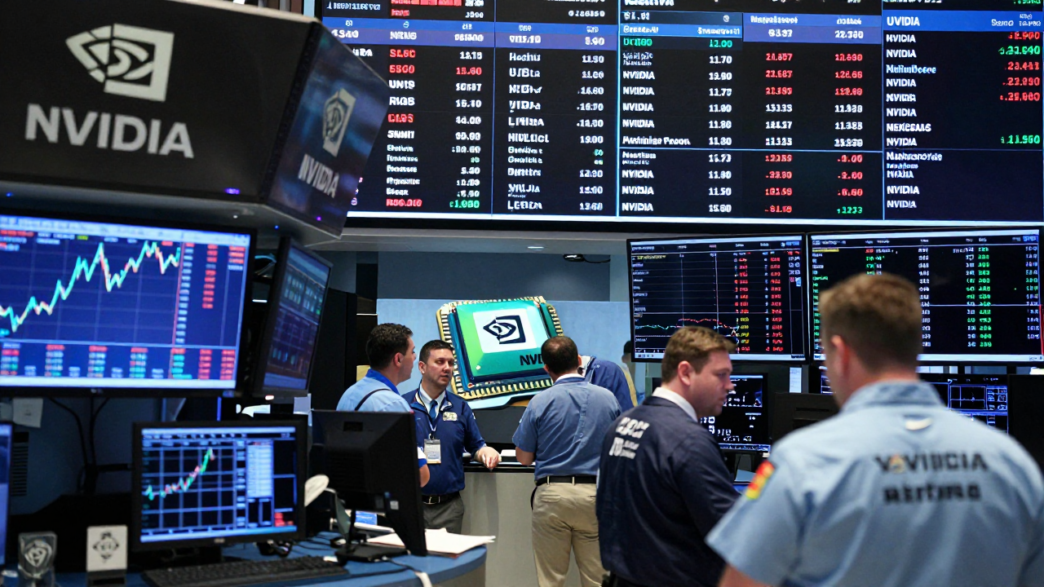
Technology shares led gains, extending a market advance that has been closely tied to investor enthusiasm for artificial intelligence. Reuters reported that Nvidia reached an all-time high, while Marvell Technology rose 6% and Cisco Systems gained 4.5%. Software stocks also advanced, reaching their highest level of 2026, as concerns about AI disrupting established software businesses appeared to ease.
The rally was broad across most S&P 500 sectors: ten rose, while health care was the sole decliner. Utilities gained 3% and consumer discretionary shares rose 1.4%. The moves showed that buying extended beyond the largest AI-linked companies, even as technology remained a central driver of the indexes’ records.
Not every company joined the advance. Seagate Technology fell 14%, a notable counterpoint in a session when the headline indexes were rising. The contrast underlined how index records can coexist with sharp losses in individual shares and did not, by themselves, indicate uniformly strong performance across the market.
Bond markets remain a key risk gauge
U.S. Treasury yields eased by roughly 3 to 4 basis points on Tuesday after a recent sell-off in government debt. The U.S. Treasury’s three-year note auction proceeded smoothly, though the notes cleared at a yield not seen since 2006. For investors, the auction offered a near-term signal of demand for government borrowing as yields had been moving higher.
Reuters columnist Jamie McGeever highlighted the regular Treasury auctions as a potential source of warning signs. Rising yields alone do not necessarily show market stress, but unusually weak auction demand—sometimes reflected in a large gap between the yield investors demand and the pre-auction market level—can draw closer scrutiny. Investors were expected to examine subsequent sales for signs of whether buyers would absorb new debt without demanding significantly higher returns.
Japan’s long-term debt market also remained under pressure: the 30-year government bond yield touched a record 4.25%, according to Reuters’ market roundup. In Europe, the spread between French and German 10-year yields narrowed by eight basis points, its biggest one-day decline since the pandemic, offering some relief after recent pressure on French bonds.
Record imports widen the U.S. trade gap
Official figures released by the U.S. Bureau of Economic Analysis and Census Bureau showed the goods-and-services trade deficit rose 13.7% in August to $105.6 billion, from a revised $92.8 billion in July. Imports increased 4.3% to $420.8 billion, while exports rose 1.4% to $315.2 billion. The deficit was the widest since March 2025, and the import total set a record.
The increase was driven primarily by goods: the goods deficit widened by $12.8 billion to $136.6 billion, while the services surplus edged up by less than $0.1 billion to $31.0 billion. Strong imports can reflect robust domestic demand, but the widening gap also weighs on the accounting of gross domestic product. Following the release, the Atlanta Federal Reserve’s GDPNow estimate for third-quarter growth was trimmed by one-tenth of a percentage point to 3.7%.
The data renewed questions about whether tariffs and efforts to shift production toward the United States would narrow the trade gap. The August figures show the deficit widened in that month; they do not, on their own, establish the longer-term effect of trade policy. The next monthly U.S. trade release was scheduled for November 4.
Oil steady as investors watch supply and conflict
Oil prices held steady, with Brent crude near $100 a barrel, while gold rose 0.7% to about $4,170 an ounce. Reuters’ column noted that oil had not climbed higher despite the ongoing U.S.-Iran conflict and disruption concerns around the Strait of Hormuz. It cited Vitol’s chief executive as saying as many as 14 million barrels a day were still being shipped from the Middle East, though the column also reported industry concern that global stockpiles were being drawn down.
The International Energy Agency was preparing to release 100 million barrels of crude and diesel from reserves, according to the column. That figure was presented as a planned release, not as a completed delivery, and the article cautioned that it would be small relative to global daily oil demand. The duration of the conflict and the eventual availability of reserve supplies remained uncertain.
Fed minutes and Treasury sales ahead
Investors were set to review minutes on Wednesday from the Federal Reserve’s September 15–16 meeting for clues on policymakers’ thinking about interest rates. The column noted that several officials, including New York Fed President John Williams, had signaled they were not in a hurry to raise rates again immediately. It also reported that softer-than-expected personal consumption expenditures inflation and nonfarm payrolls had shaped market expectations, with futures pricing an 80% chance of no change later in October.
Other scheduled events for Wednesday, October 7, included India’s interest-rate decision, Japan’s October Tankan survey, German industrial production data for August and a U.S. Treasury auction of $39 billion in 10-year notes. The Fed minutes and bond sale were the clearest near-term tests of whether rate expectations and investor appetite for government debt would continue to support risk-taking in equities.