

Updated:
The Federal Reserve will reorganize its bank-supervision operations into five geographic regions, replacing the current arrangement tied to its 12 Reserve Banks, Vice Chair for Supervision Michelle Bowman said Tuesday, October 6, 2026. The new regions will each have a leader accountable for supervisory activity, while examiners will remain in existing Reserve Bank locations and continue overseeing the banks they currently supervise.
Bowman announced the change in prepared remarks at the 2026 Community Banking Research Conference in St. Louis. She said the realignment is intended to clarify who is responsible for supervisory decisions and make it easier to coordinate with state and federal regulators. The Fed did not specify when the new structure will take effect or how states will be divided among the five regions.
The reorganization is part of a wider effort to change how the central bank examines banks and applies regulatory requirements. Bowman also said the Fed would consider updating fixed-dollar asset thresholds later this year, with a mechanism to adjust them every five years for inflation and economic growth.
Five regions, with examiners staying in place
Under the Fed’s existing structure, supervision is carried out and overseen across the 12 regional Reserve Banks, while the Board of Governors in Washington sets examination policy. Bowman said the division has left responsibility for the function with the vice chair for supervision while its execution rests with the Reserve Banks, creating what she described as a mismatch between authority and accountability.
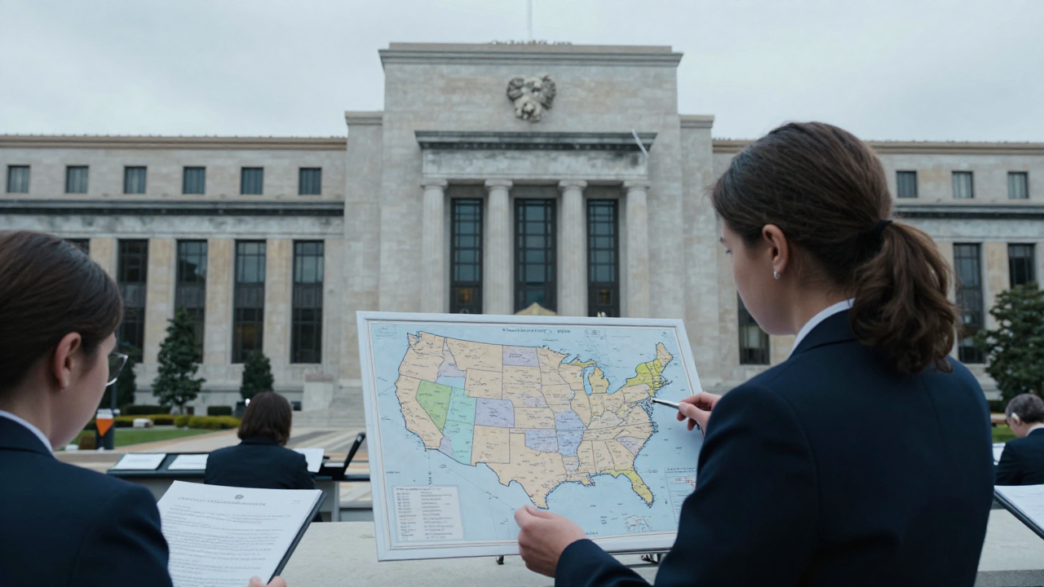
The planned structure will organize supervision into five regions, with a leader in each responsible for all supervisory activity there. The regions will be aligned to reflect state boundaries rather than simply follow the existing Reserve Bank district map, according to Bowman’s remarks.
The change is not described as a relocation of the examination workforce. Fed examiners will remain in their current Reserve Bank offices and continue supervising the same banks, while the leadership structure above them changes. Bowman said organizing around state lines should improve coordination with state banking authorities, which jointly supervise state member banks with the Fed.
Bowman points to committee delays and accountability
Bowman also criticized the Fed’s reliance on committees in its supervisory process. She said committees could help share information but, over time, had contributed to delays, obscured decision-making responsibility and discouraged examiners from acting promptly when they identified risks.
In her account, the structural concerns were highlighted by an independent review of the Federal Reserve’s supervision of Silicon Valley Bank. Bowman said the review identified longstanding issues in how supervisory responsibilities were organized. The Fed speech did not present the five-region plan as a response to a single bank failure; rather, it described the review as an impetus to address broader problems in how the system assigns and exercises supervisory authority.
The speech did not detail which committees will be changed or eliminated, name the five regional leaders, or explain how disputes between regional leaders and the Board in Washington will be resolved. Bowman said the restructuring is intended to support clearer decision-making and a more consistent application of supervision while retaining local examination work.
Asset thresholds and community-bank rules also under review
Alongside the organizational changes, Bowman said the Board later this year will consider revising fixed-dollar thresholds in its regulations and creating a process to update them every five years. She argued that thresholds left unchanged can become miscalibrated as the economy grows, potentially subjecting banks to requirements that no longer reflect their size, activities or risk.
The Fed also plans to consider broader changes to asset-based supervisory categories and its framework for tailoring requirements on large banks. Bowman noted that the community-bank definition has generally used a $10 billion asset ceiling for the past 15 years. She said the central bank wants to consider how business model and risk profile, alongside size, should shape supervisory expectations.
These are plans for consideration, not adopted rule changes. Bowman’s remarks did not specify a proposed replacement threshold or the details of a revised large-bank framework. The Board has already proposed revising Regulation O, which governs certain loans to bank insiders, and said in July that the rule had not been comprehensively updated since 1979.
Broader shift toward risk-focused examinations
The five-region structure accompanies the Fed’s stated effort to focus examinations on vulnerabilities that could materially harm a bank’s financial condition. Bowman pointed to supervisory operating principles introduced in October 2025, which she said direct examiners to identify material risks early and take prompt, proportionate action.
She said the Fed has also been working with other regulators on revisions to the CAMELS rating system, which evaluates banks across capital, asset quality, management, earnings, liquidity and sensitivity to market risk. The proposed changes described in her speech would give greater attention to material financial risks and make the management component less likely to determine a bank’s overall rating on its own.
Other parts of the broader agenda include updating supervisory guidance and making expectations clearer to banks before examinations. Bowman said the Fed would continue to pursue a risk-focused approach while maintaining its responsibilities for bank safety and soundness and financial stability. The next concrete steps identified in her remarks are the Board’s consideration of threshold changes later in 2026 and further work on the supervisory structure; no implementation date for the five regions was announced.