

Updated:
North Dakota has become the fastest-growing state for soybean plantings, with acreage more than tripling since 2000 as Chinese demand, domestic biofuel production and changes in farm technology reshaped its crop mix. The expansion has made soybeans one of the state’s most planted and valuable crops, displacing wheat’s traditional prominence even as farmers face a persistent yield gap and increasing weather risks.
Two processing plants opened in the state since 2023, adding local buyers that together can handle nearly half of North Dakota’s projected 2026 soybean harvest. That capacity offers farmers an alternative to shipping beans to export terminals, but this year’s crop is under pressure: the U.S. Department of Agriculture’s October 7 estimate put the state’s average yield at 30 bushels per acre, the lowest in five years.
Plantings grow, while yields lag
North Dakota’s soybean acreage has expanded far more rapidly than the national total, which rose 17% over the same period, according to Reuters. Herbicide-tolerant seed varieties made the crop easier to grow in a state with a short season, while declining wheat demand and a warmer climate also formed part of the shift. Soybeans now generally rank at or near the top among the state’s crops by acreage and value.
The expansion has not erased a productivity challenge. North Dakota’s average soybean yield has hovered around 35 bushels per acre over the past decade, compared with a national average near 53 and higher yields in neighboring Minnesota and South Dakota, Reuters reported. The gap matters because researchers and growers are trying to raise output in a region where a short, often dry summer limits the time available for crops to mature.
USDA’s latest state overview listed 6.85 million acres planted and forecast production of 203.7 million bushels for 2026, based on the 30-bushel yield estimate. That estimate is notably below the roughly 35-bushel-per-acre average cited for the preceding decade. It is a forecast, not a final harvest tally.
Weather and breeding complicate the outlook
North Dakota experienced an exceptionally warm and dry summer in 2026, according to state climatologist Daryl Ritchison, Reuters reported. The state’s temperatures have risen by more than 2.6 degrees Fahrenheit since 1900, NOAA figures cited in the report show. Warming can extend the usable growing season, but it does not remove the risk of drought; North Dakota is also vulnerable to flooding.
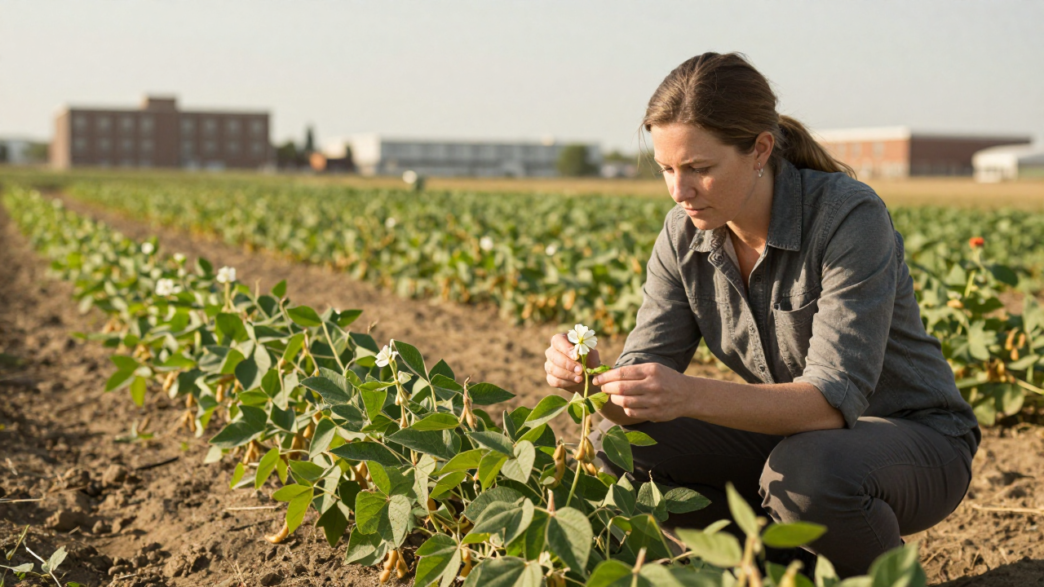
At North Dakota State University in Fargo, plant breeder Carrie Dottey is hand-crossing soybean lines from Illinois and Nebraska with locally adapted plants. Her work is intended to identify varieties that can produce well during the state’s short season and endure dry conditions, including farther west near Williston. Dottey’s breeding work reflects the practical limit on further acreage growth: varieties must mature quickly and reliably, not simply tolerate warmer average temperatures.
Farmers have also adjusted cultivation to conserve soil moisture. Reuters reported that some leave crop residue on fields rather than plowing it under, using the remaining stalks as a protective layer that can reduce erosion and help retain water. Those measures offer a response to dry conditions but do not guarantee yields when rainfall is limited.
Local crushers add a market alongside exports
China’s livestock sector helped create a major market for North Dakota soybeans during the 2000s and 2010s. Much of the crop traveled by rail to Pacific Northwest terminals for export. U.S.-China trade conflicts have since sharply reduced soybean exports to China, Reuters reported, making domestic processing more important to a state whose production had been tied closely to overseas demand.
The Green Bison plant at Spiritwood is a joint venture between Archer-Daniels-Midland and Marathon Petroleum. North Dakota’s state government says the facility can process up to 150,000 bushels per day and produce soybean oil for Marathon’s renewable-diesel operation in Dickinson, as well as soybean meal for regional animal agriculture. Green Bison began accepting soybeans in September 2023.
The second facility, North Dakota Soybean Processors in Casselton, is a joint venture formed by CGB Enterprises and Minnesota Soybean Processors. Together, the Spiritwood and Casselton plants can process 90 million bushels annually, close to half of the state’s projected 2026 harvest. The plants turn beans into oil and meal, creating local outlets for the crop rather than relying solely on export shipping.
Farmer Evan Montgomery told Reuters that Casselton was offering roughly 50 cents per bushel more than nearby grain elevators that depend on exports. That comparison is specific to his area and reported at the time of the story; it does not establish a statewide price premium. Senator Kevin Cramer, a North Dakota Republican, identified domestic demand for biodiesel and other bioproducts as a potential source of further opportunity.
Biofuel demand offsets, but does not replace, exports
The rise of soy-based biofuel demand has partly offset weaker exports to China, as U.S. renewable-fuel requirements have supported demand for soybean oil. The new crushers give that demand a more direct connection to North Dakota growers by processing beans within the state. Their combined capacity, however, is not the same as a guarantee that every bushel will find a buyer at a favorable price.
North Dakota’s soybean expansion now rests on several forces that do not always move in the same direction: overseas demand helped establish the crop, domestic processing has broadened the buyer base, and breeding research is aimed at lifting yields. The immediate production outlook remains constrained by this year’s dry conditions, while the final harvest and the degree to which local facilities absorb the crop remain to be determined.