

Updated:
Applied Digital reported a sharp rise in fiscal first-quarter revenue as it expanded its AI data-center business, while spending on property and equipment surged to more than $2 billion. The results, released October 7, underscore the capital demands confronting infrastructure providers as technology companies pursue large new financing arrangements for chips and computing capacity.
The Dallas-based company posted $341.9 million in revenue for the three months ended August 31, up from $80.9 million a year earlier. It generated $64.4 million in adjusted EBITDA, a non-GAAP measure, but reported a $221 million net loss attributable to common shareholders from continuing operations. Applied Digital had $3.7 billion in cash, cash equivalents and restricted cash and $6.4 billion in debt at quarter-end.
Revenue growth came with sharply higher investment
Applied Digital’s purchase of property, equipment and other assets totaled about $2.075 billion during the quarter, compared with $249.9 million in the same period a year earlier. Operating cash flow was $63.9 million, according to the company’s cash-flow statement, while financing activities supplied $1.54 billion, including $1.65 billion in long-term borrowings and proceeds from preferred stock issuance.
The scale of the investment reflects the gap between bringing facilities online and the financial resources required to build them. The company’s results show both revenue gains from tenant fit-out services and new data-center rent, and the substantial financing and construction costs associated with expanding capacity.
Services revenue rose to $262.8 million from $80.9 million, helped by a roughly $157.2 million increase in tenant fit-out services and $23 million in GPU hardware sales related to subsidiary ChronoScale. Data-center rental and other revenue, which had been absent in the year-earlier quarter, reached $79.1 million, including $65.8 million in base rent and $13.3 million in tenant recoveries.
Leases underpin a large development pipeline
Applied Digital said it had leases for approximately 1.41 gigawatts of critical IT load across five campuses as of August 31. Those agreements represent about $36 billion in contracted revenue over their initial terms, or approximately $86 billion if all renewal options are exercised, the company said. The figures are contractual estimates extending over the leases’ terms, not revenue already earned.
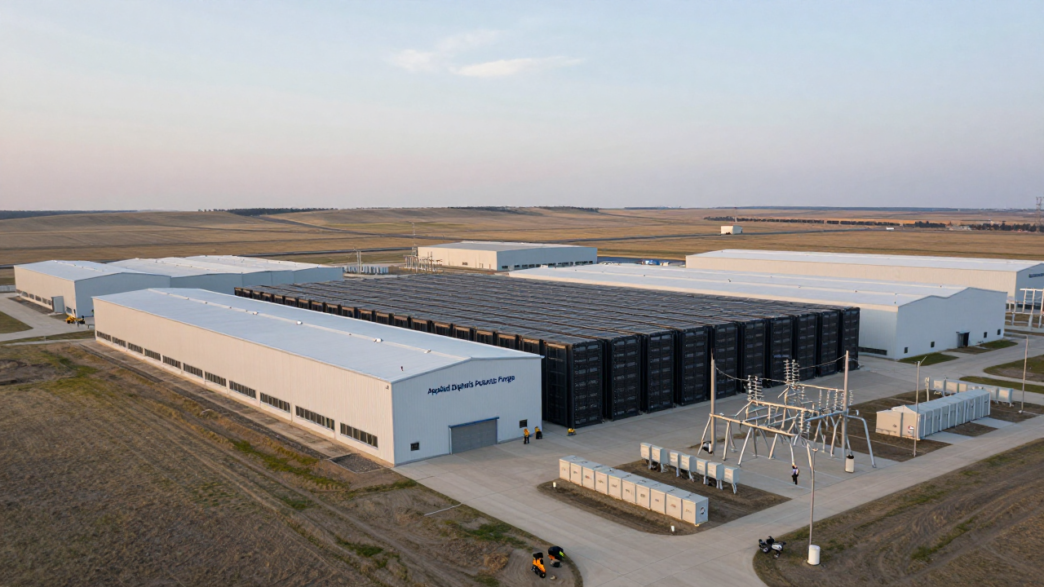
The company’s sites include three Polaris Forge campuses in North Dakota, Delta Forge 1 in Louisiana and Delta Forge 2 in Alabama. It said Polaris Forge 1’s second 75-megawatt phase became ready for service on October 1, after the quarter ended, bringing operational critical IT load at that campus to 250 megawatts. Applied Digital expects initial operations at Polaris Forge 2 to lift delivered capacity across its North Dakota campuses to 300 megawatts by the end of 2026.
Applied Digital also announced an agreement for up to approximately one gigawatt of potential power capacity in Finland, its first step outside the United States. The company described the arrangement as an early, limited-exposure move, while saying its near-term development focus remains its U.S. portfolio.
Debt and interest costs are rising
The spending expansion coincided with a marked increase in borrowing costs. Applied Digital’s interest expense climbed to $77.4 million from $8 million a year earlier, which the company attributed to increased debt arrangements. Its reported $221 million continuing-operations net loss attributable to common stockholders compared with $18.5 million in the prior-year quarter.
The company also reported adjusted net loss of $4.1 million, or one cent per diluted share, and adjusted EBITDA of $64.4 million. These non-GAAP measures exclude certain items and ChronoScale results; the company cautions that they are supplemental and should not be treated as substitutes for GAAP results. ChronoScale, in which Applied Digital holds about 96%, is consolidated in its GAAP financial statements.
Applied Digital’s capital requirements arrive amid reports of other prospective AI-related financing. The Wall Street Journal reported that Broadcom was working to raise more than $50 billion for a custom chip being developed with OpenAI, while it also reported Oracle discussions with Apollo and Goldman Sachs regarding a large chip purchase. The Financial Times separately reported that SpaceX was in talks with lenders about $40 billion in financing to buy Nvidia processors. These were reported discussions and financing efforts, not completed transactions confirmed in the market report.
Market backdrop adds to financing questions
Investing.com reported that U.S. stock-index futures were lower early Thursday, October 8, as investors monitored rising bond yields, oil prices and concerns about sovereign debt markets. It cited higher yields in Europe and a 10-year U.S. Treasury yield of 5.327% at the time of its report. The figures describe conditions at that early-morning reporting point and may not represent later trading.
Analysts at Vital Knowledge, as cited by Investing.com, said the pipeline of AI-linked borrowing could keep pressure on Treasury yields while the financing wave continues. The reported Applied Digital results provide a company-level example of the issue: revenue is growing quickly, but the associated buildout is capital intensive and funded through a combination of cash, debt and other financing.
What remains ahead
Applied Digital said its conference call to discuss the results was scheduled for October 7 at 5 p.m. Eastern time. Its release also outlined further campus development, but did not specify a new financing target or announce a fresh debt deal in connection with the quarterly results.
For the quarter, the company’s operating profile therefore combined new rent and a large contracted project pipeline with a substantial reported net loss, elevated interest expense and investment spending far above operating cash flow. How quickly its construction pipeline becomes operational capacity—and how the company funds that expansion—remains central to understanding the financial results.