

Updated:
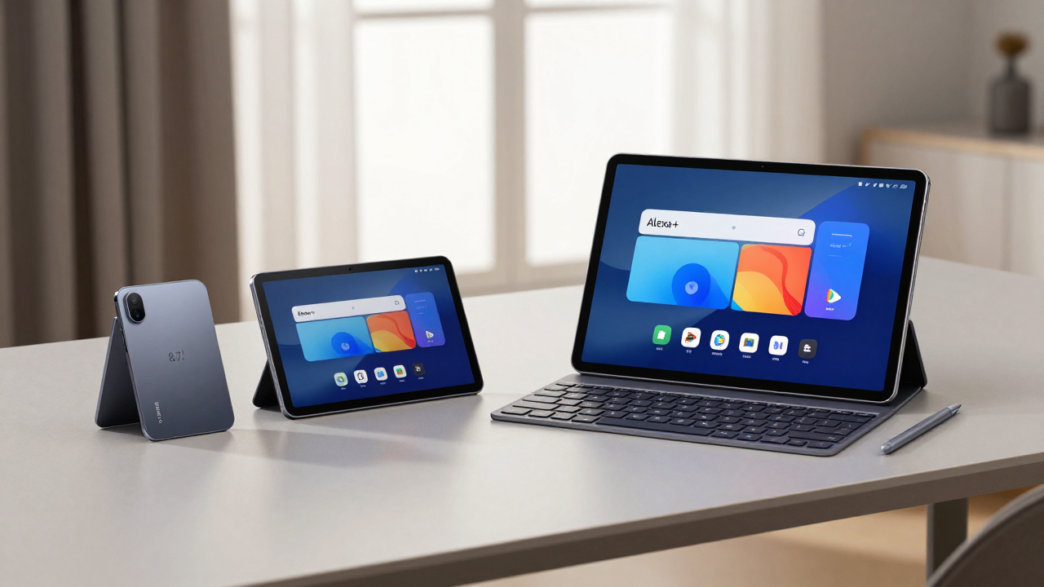
Amazon on Thursday, October 8, unveiled its first tablets running Android, a new product line that pairs access to Google’s Play Store with the company’s Alexa+ assistant. The three devices start at $229.99 and are scheduled to go on sale in the United States, Mexico and Canada on October 14.
The announcement marks a change from Amazon’s established Fire tablet approach. Those devices use Fire OS and Amazon’s own app store; the new tablets instead offer the Google Play Store and apps including YouTube, Netflix and Gmail. Amazon told TechCrunch the models are a new line with new hardware and software, rather than simply rebranded Fire tablets.
Three models, from an 8.7-inch tablet to a 12-inch Pro
The lineup comprises the Amazon Alexa Tablet 8, the Alexa Tablet 11 and the higher-priced Alexa Tablet 12 Pro. Amazon lists starting prices of $229.99, $329.99 and $499.99, respectively. The 12 Pro’s anti-glare Nanomatte configuration starts at $549.99.
The 8.7-inch Tablet 8 is the smallest model, weighing 329 grams, and comes with 4GB of RAM and 64GB of storage at its listed base price. The 11-inch model starts with 8GB of RAM and 64GB of storage. Amazon says it has a 2.5K display with a 90Hz refresh rate and up to 15 hours of video playback.
The 12 Pro has a 12-inch, 120Hz display and starts with 8GB of RAM and 128GB of storage. Amazon says higher configurations offer up to 16GB of RAM, and claims the model delivers nearly three times the processing performance and nine times the graphics performance of any tablet it has previously shipped. Those performance comparisons are Amazon’s claims, not independently reported test results.
Google Play access changes the software proposition
Fire tablets have relied on Amazon’s own operating system and app marketplace, which has meant that some popular apps available on mainstream Android devices were not readily available through the Fire app store. With Google Play access, the new tablets are positioned to offer a wider selection of familiar Android apps alongside Amazon services such as Kindle, Prime Video and Amazon Music.
Amazon’s shift follows a period of reporting about a planned move toward Android for its tablet business. In 2025, Reuters reported that Amazon was considering an Android tablet project, citing people familiar with the matter. That report described plans under development at the time; the products announced Thursday are now confirmed, but the launch does not establish whether every future Fire tablet will move to Android.
Alexa+ is integrated across the new range
Amazon says Alexa+ is built into all three models. Users can activate the assistant by voice or through an on-screen button, and the company describes features that include answering questions, controlling connected smart-home devices and offering help based on what is displayed.
Amazon says its On-Screen Intelligence features are off by default and require users to opt in. The company says users can choose when Alexa listens or accesses the screen, and that an indicator appears when Alexa is active. These are details provided by Amazon; independent assessments of the privacy controls were not included in the launch coverage reviewed.
The tablets also introduce a Kindle reading mode that, according to Amazon, silences notifications, reduces blue light and can extend battery life to as much as 20 hours while reading. The 12 Pro will have optional accessories: a keyboard priced at $149.99 and a pen at $89.99.
Sales begin October 14 in North America
Amazon says the three tablets will be available in the United States, Mexico and Canada starting October 14, with shipments to begin that day. The company lists the United Kingdom, Germany, France, Italy and Spain for an October 19 rollout. Availability through Amazon and selected retailers, including Best Buy and Target, was reported in connection with the announcement.
The launch places Amazon’s new Android devices at higher starting prices than the company’s traditional low-cost Fire tablets, while introducing Google Play access and Alexa+ as central features. The company has not disclosed sales targets or provided independent evidence for its performance comparisons; how the new line will sit alongside Fire models over the longer term also remains unclear.