

Updated:
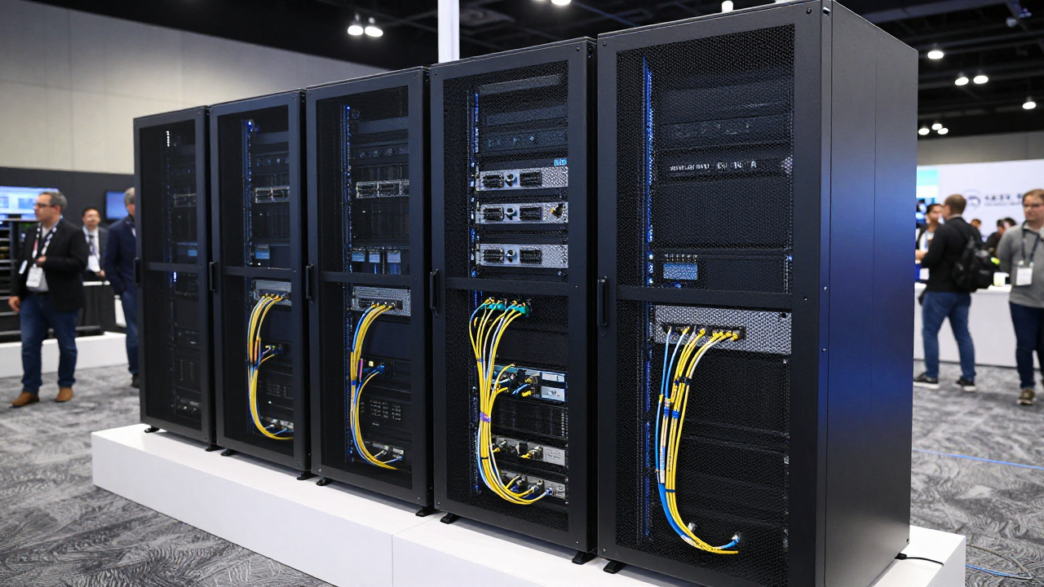
Jefferies has identified faster optical links, data-center networking and high-voltage power as key topics to watch at next week’s Open Compute Project Global Summit in San Jose, California. In a report published October 7, the brokerage named MACOM Technology Solutions and Lumentum Holdings as its preferred exposures to the shift toward 1.6-terabit-per-second (1.6T) optical connectivity, while pointing to potential product demonstrations and architecture discussions involving several other chip and infrastructure companies.
The four-day summit is scheduled for October 12–15 at the San Jose Convention Center. The Open Compute Project’s program spans AI computing, networking, power, cooling and other data-center infrastructure; its published agenda includes sessions on 800-volt direct-current distribution, 1.6T interconnects and AI rack design. Jefferies’ report frames the event as a venue for gauging technical progress, but the subjects it highlights are not, by themselves, evidence of new orders or commercial deployments.
Optical links and network protocols in focus
Jefferies expects the transition to 1.6T links to be a central topic, and named MACOM and Lumentum as its preferred ways to gain exposure to that area. The brokerage also said it would track the relative roles of Ethernet, UALink and Nvidia’s NVLink in scale-up connectivity, which links processors within increasingly large AI systems.
On optical packaging, the firm highlighted the timing and component implications of near-packaged optics (NPO) and co-packaged optics (CPO). Both approaches place optical components closer to computing or switching silicon than conventional pluggable modules do, but their timing and eventual use in production remain questions for the industry. Jefferies also said it would watch for further information on memory architectures aimed at inference workloads.
The firm pointed to Broadcom as an early potential beneficiary in digital signal processor (DSP) share at optical-module makers. That is Jefferies’ assessment, rather than a disclosed award or confirmed market-share figure. The brokerage also said Nvidia’s participation in OCP was becoming more significant as the company advances its NVLink Fusion platform and presents itself within a more open ecosystem.
Power architecture moves up the agenda
Power delivery is another focus. OCP’s official program lists 800V DC and direct-to-server power among topics tied to higher-density AI racks, alongside liquid cooling and facility design. The summit is also scheduled to include discussions related to grid interconnection and Nvidia’s MGX server platform, according to Jefferies’ account of the event agenda.
Jefferies said it expects to see 400-volt technology in the OCP Diablo 400 rack and suggested Nvidia could push rack power higher in systems it referred to as Oberon and Taycann. Those points were presented as expectations in the brokerage note, not as confirmed new product announcements. The firm identified Texas Instruments, Analog Devices and onsemi as companies whose power-semiconductor opportunities could be illuminated by discussions of 800V systems, grid connections and cooling.
OCP says its broader work on low-voltage direct current infrastructure is intended to support common approaches to next-generation data centers. Its summit agenda includes 800V DC engineering, while the organization’s published material describes ongoing work on standardization and interoperability. The practical pace of adoption, and which components suppliers ultimately benefit, remain issues for operators and vendors to resolve.
AMD keynote and Credo demonstration to watch
AMD Chair and CEO Lisa Su is scheduled to deliver an opening keynote on October 12, the company confirmed. Jefferies said AMD’s Helios rack-scale AI systems are expected to begin shipping to customers, including Microsoft, in late 2026, and argued that attention will increasingly turn to execution and deployment. The summit keynote is a scheduled appearance; it does not in itself confirm shipment timing or volumes.
The brokerage also highlighted Credo Technology Group’s expected presentation of an active LED cable (ALC) using microLED technology. Jefferies said it would look for customer information and detail on any potential micro-vertical-cavity surface-emitting laser roadmap. Credo has previously described its microLED-based ALC work as targeting links of up to 30 meters, and has said the technology could address connectivity within AI data-center networks.
Jefferies further noted Marvell Technology’s announced 100G-per-lane UALink switch, which the firm said should reach tape-out later this year. Tape-out is a chip-development milestone when a design is sent for manufacturing; it is not the same as a product launch or customer deployment. The summit runs through October 15, but the public schedule does not establish when or whether every company will make additional commercial announcements. The available reporting describes Jefferies’ watch list and expectations, not confirmed new contracts or sales.