

Updated:
Elon Musk accused unnamed Indian business interests of blocking SpaceX’s Starlink satellite internet service, alleging on October 7 that they were seeking to preserve a “monopolistic chokehold” over the country’s consumers. The charge came as Starlink awaits final security clearances and spectrum assignment before it can begin commercial operations in India.
India’s Ministry of Communications responded on October 8 that the country’s satellite communications framework is “fair and non-discriminatory.” The ministry said three operators, including Starlink, had licences but remained at broadly the same regulatory stage, with security requirements still to be met. It did not name Musk in its statement.
Musk did not identify the people or companies he accused, and no public evidence has established that Indian telecom operators or their owners are responsible for the pending clearances. His comments have intensified attention on a regulatory delay that SpaceX says it is prepared to move beyond, while New Delhi maintains that satellite providers must meet its security conditions.
Government says providers face common requirements
The ministry said India uses a common authorisation framework for telecommunications, including satellite services, and that licensees must comply with security conditions. It said Starlink, Jio Satellite Communications and Bharti-backed Eutelsat OneWeb were “at broadly the same regulatory stage,” countering the suggestion that the process was aimed specifically at Musk’s company.
A licence is not by itself permission to begin selling service. The companies still need to satisfy security conditions and obtain spectrum assignment, which would allow them to use the necessary frequencies. The government has not announced a date for final approvals or commercial launches.
Starlink received its Indian satellite communications authorisation in June 2025, a major step after years of efforts to enter the market. But security scrutiny has continued. Reports in June 2026 said agencies under India’s Home Ministry had withheld final clearance; the reported concerns included the use of Starlink terminals in conflict zones and the government’s ability to ensure compliance from a foreign-operated network.
SpaceX says infrastructure is ready
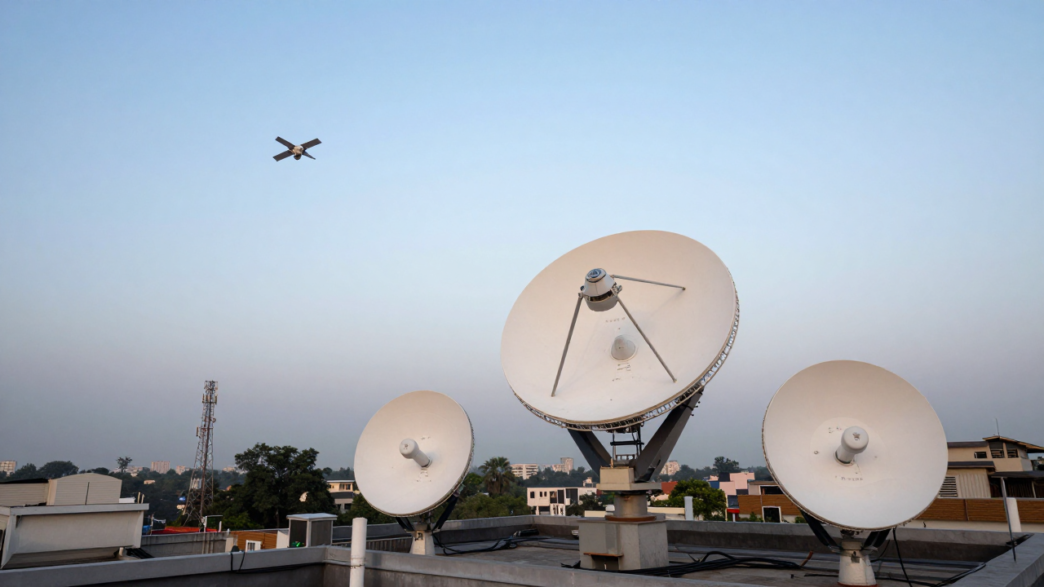
Musk’s post followed remarks by Lauren Dreyer, SpaceX’s vice president for Starlink business operations, at the India Mobile Congress. Dreyer said the company had spent five years working with Indian regulators, telecom operators and industry stakeholders, and had built 20 gateway sites with hundreds of antennas across the country.
She said Starlink had established India-specific controls to address security and regulatory requirements, including keeping Indian user data within the country. Dreyer said the company was ready to serve customers once the remaining government approvals were complete. Those statements describe SpaceX’s preparations, not an announcement that regulators have approved operations.
Starlink has also pursued ties with incumbent operators rather than relying solely on direct competition. It signed agreements with Bharti Airtel and Reliance Jio in March 2025 covering cooperation on equipment distribution and connectivity, and has discussed possible uses with state governments, including in remote communities and public institutions.
Competition and security questions overlap
India’s satellite internet market includes companies linked to established telecom groups. Eutelsat OneWeb is backed by Bharti Airtel, while Jio Satellite Communications is part of the Reliance Jio group. Those groups have large existing customer bases, and their satellite ventures are also waiting for approvals, according to the ministry.
The commercial stakes are significant, but the regulatory questions extend beyond market competition. Low-Earth-orbit satellite networks operate differently from systems built mainly on domestic mobile towers and fibre, raising questions for governments about security oversight, control of terminals and responses to requests from foreign authorities.
Earlier disputes over spectrum policy also exposed competing views about how satellite services should be regulated. Reliance had argued for an auction of satellite spectrum, while Musk advocated administrative allocation, as India considered its approach. That debate is distinct from the current security clearances, and does not establish that competitors caused the present delay.
Rural connectivity is part of Starlink’s pitch
SpaceX has presented Starlink as a way to reach areas where conventional infrastructure is difficult or slow to build. Satellite service can connect a user terminal directly to orbiting spacecraft, rather than requiring a nearby fibre connection or mobile tower. That could be relevant to remote communities, though the service’s availability, price and customer reach in India remain unannounced.
India had 1.093 billion internet subscriptions in March 2026, according to figures cited by Financial Express. Rural areas accounted for 440.87 million subscriptions, with a subscription density of 48.31 connections per 100 people, compared with 126.80 per 100 people in urban areas. These figures measure subscriptions, not necessarily unique users, and do not by themselves establish the size of the market Starlink could win.
India’s government has said it seeks broad connectivity, but has not relaxed the requirement that satellite operators meet the country’s security rules. SpaceX has said it has designed its operations around those requirements; regulators have not publicly confirmed that all conditions are satisfied.
No launch date set
For now, the next steps are regulatory rather than operational: Starlink and the other licensed providers need to complete security requirements and secure spectrum access. No launch schedule, spectrum allocation timetable or final clearance date was specified in the ministry’s October 8 response.
Musk’s accusation frames the delay as protection of incumbent business interests, but the named companies were not identified by him and have not been shown to have blocked approval. The government’s account is that all three licensed operators are at a similar stage. Whether Starlink can satisfy the outstanding conditions—and when any of the providers can begin service—remains unresolved.