

Updated:
Voters in Bosnia and Herzegovina went to the polls on Sunday, October 4, in a general election that could shape the country’s stalled path toward European Union membership and the balance of political influence among the United States, Russia and the EU. About 3.4 million registered voters were choosing members of the country’s central tripartite presidency and national parliament, alongside representatives and leaders in its two entities.
The vote comes amid public frustration over economic conditions, slow progress toward EU accession and a prolonged political crisis. Parties rooted in the country’s ethnic communities have repeatedly blocked decisions at the central level, where governments must work across Bosnia’s complex governing structure.
Polls were scheduled to close at 7 p.m. local time, with preliminary results expected later on Sunday from the Central Election Commission. At the time of reporting, no election outcome had been established. The result may indicate whether the parties can form a more functional central government, but it will not by itself resolve the reforms required to advance accession negotiations.
Election spans Bosnia’s central and entity governments
The ballot covers several layers of government created under the 1995 Dayton peace accord, which ended Bosnia’s 1992–95 war and established a system intended to manage divisions among Bosniaks, Serbs and Croats. Voters are choosing the three members of the central presidency, lawmakers for the national parliament, and officials and assemblies in the Federation of Bosnia and Herzegovina and Republika Srpska.
Bosnia’s Central Election Commission said more than 3.4 million people were registered to vote. The system links two entities with distinct political constituencies: the Federation, where Bosniaks and Croats are the main communities, and the Serb-dominated Republika Srpska. Central institutions connect the entities, but political disputes have often made decision-making difficult.
Reuters reported that the contest pits the Bosniak Party of Democratic Action, or SDA, the Serb Alliance of Independent Social Democrats, or SNSD, and the Croat HDZ BiH against multi-ethnic opposition coalitions led by the Social Democratic Party. Reuters cited Poliwave tracking figures showing the SDA at 21.4% nationally and the SDP at 16.7%; those figures were not official election results.
EU bid remains stalled before formal talks
Bosnia received EU candidate status in December 2022, and the European Council agreed in 2024 to open accession negotiations. However, formal negotiations have not begun. Reuters reported that domestic political leaders have yet to complete requirements including stronger judicial oversight and anti-corruption legislation.
The election therefore matters partly because the central government would represent Bosnia in the accession process. Reuters reported that continued disagreements among ethnically based parties could further delay progress. The vote itself does not start negotiations; the country still needs to meet the necessary conditions and secure the next steps from EU institutions.
Economic dissatisfaction is also a prominent backdrop. Reuters cited voter frustration over an economic slowdown and the pace of EU talks, while AP reported concerns among citizens about living standards and young people leaving the country. The competing focus on daily pressures and nationalist politics has left voters weighing practical concerns against long-running disputes over Bosnia’s political structure.
Dodik remains a central figure despite office ban
In Republika Srpska, attention has focused on Milorad Dodik, the former entity president and leader of the SNSD, even though he is not on the ballot. AP reported that Dodik is barred from public office after a conviction for defying decisions by the international envoy overseeing implementation of the Dayton agreement. His party was expected to perform strongly in the entity, but the outcome remained unknown during voting.
Dodik has advocated close ties with Serbia and Russia and promoted separation of Republika Srpska from the rest of Bosnia. AP reported that he had recently met Russian President Vladimir Putin in Moscow and that his party’s final rally in Banja Luka was attended by Russia’s ambassador. The campaign has thus played out against concerns in Western capitals about renewed instability and wider competition for influence in the Balkans.
Reuters also reported a separate US-linked energy issue: a proposed $1.5 billion project to import American liquefied natural gas. The EU raised concerns that the company selection lacked competitive transparency, according to Reuters. The election does not decide the project, but it is part of a broader contest over Bosnia’s external partnerships and policy direction.
New voting technology faces its first general-election test
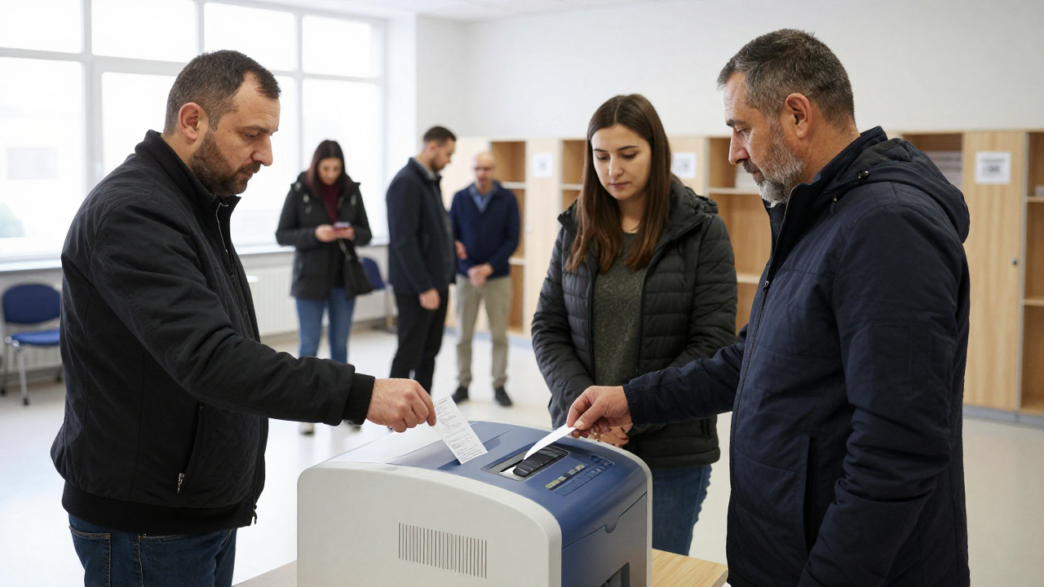
Authorities introduced electronic voter identification and ballot scanning for the first time in a general election, aiming to address concerns about irregularities and organized manipulation in previous contests. The Central Election Commission had confirmed that technical conditions were in place ahead of election day.
Implementation was not seamless: AP journalists reported delays at several polling places where the new equipment caused problems, and other reporting also noted interruptions. The technology’s purpose is to strengthen confidence in voting, but officials had not yet reported a nationwide assessment of its performance when polls were open.
The next scheduled milestone was the release of preliminary results after polls closed Sunday evening. Those figures were expected to show the initial distribution of support; the composition of governments and the pace of EU-related reforms would depend on what parties won and whether they could reach agreements across Bosnia’s divided institutions.