


Updated:
Belgian physicist Francis Halzen won the 2026 Nobel Prize in Physics on Tuesday for his contributions to the IceCube Neutrino Observatory and the discovery of high-energy neutrinos from astrophysical sources. The Royal Swedish Academy of Sciences announced the award in Stockholm, recognizing work that helped turn Antarctic ice into a detector for particles arriving from the distant universe.
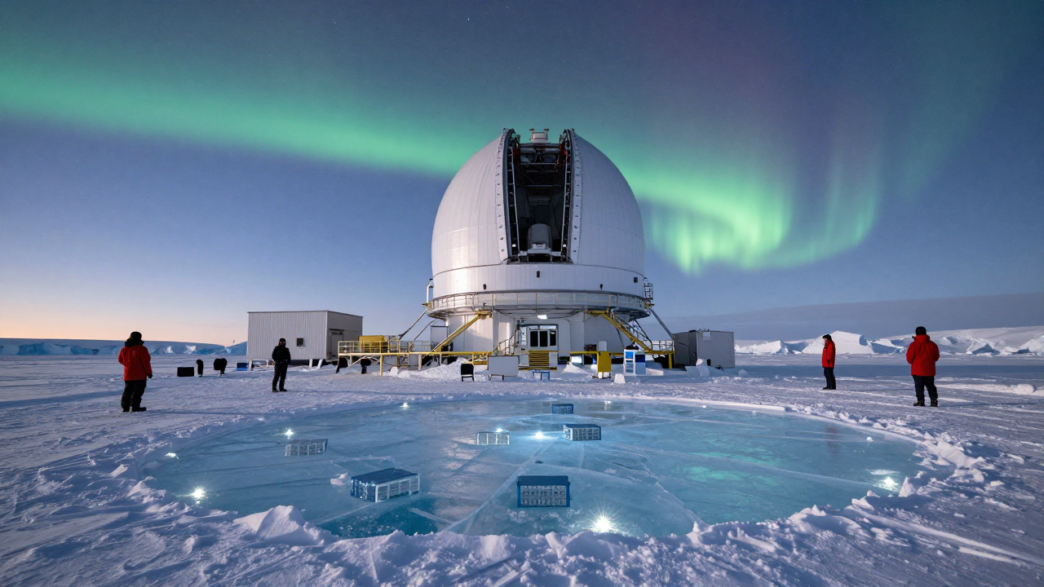
Halzen, 82, is a professor at the University of Wisconsin–Madison, which leads the IceCube project. The prize carries 12 million Swedish kronor, about $1.2 million. IceCube is not a telescope in orbit: it is a detector embedded in the ice beneath the South Pole, where sensors register light produced when neutrinos rarely interact with matter.
A detector built into Antarctic ice
Neutrinos have extremely small mass and no electric charge, and they pass through ordinary matter with little interaction. That makes them difficult to detect, but also allows them to travel across vast distances from energetic cosmic environments without being deflected in the way charged particles are.
The Nobel announcement said Halzen recognized that South Pole ice could be used to track these particles. IceCube instruments a cubic kilometre of ice with light sensors. When a neutrino interacts with an atomic nucleus in or near the detector, the resulting charged particles can produce light that the sensors record.
The observatory is operated at the Amundsen–Scott South Pole Station. NASA’s mission description says its detector uses 86 strings of optical sensors extending to around 2,500 metres below the glacier’s surface. The University of Wisconsin–Madison is the lead institution, and the U.S. National Science Foundation is the facility’s primary funder.
From early proposals to a new kind of astronomy
Halzen’s effort to develop neutrino detection at the South Pole dates to the 1980s. The University of Wisconsin says he initiated the project that developed into IceCube, following earlier work on the Antarctic Muon and Neutrino Detector Array, or AMANDA, which tested whether ice could serve as a large-scale detection medium.
Building a detector at the South Pole required an international research and engineering effort. In its announcement, the Nobel committee credited Halzen’s scientific leadership and vision in establishing the observatory; the prize itself was awarded to him, rather than to the wider IceCube collaboration.
Committee chair Mark Pearce said the project had created an instrument that opened a new form of astronomy. The recognition is for both the observatory and the discovery of high-energy neutrinos of astrophysical origin—not for the discovery of neutrinos themselves, which were identified decades earlier.
Why high-energy neutrinos matter
Cosmic neutrinos can provide information about extreme astrophysical environments because they travel largely unhindered from their sources. IceCube’s measurements therefore give researchers a way to study distant and energetic processes using particles that complement observations made with light and other signals.
The distinction between ordinary and high-energy neutrinos is important: neutrinos are abundant, but those energetic enough to reveal particularly powerful cosmic processes are rare and hard to capture. The Academy said IceCube has enabled researchers to detect neutrinos associated with extremely energy-rich processes in the distant universe.
IceCube’s wider research continues beyond the Nobel-recognized discovery. Its collaboration studies neutrino physics and astrophysics, and the observatory can issue alerts to researchers when a candidate event may warrant follow-up observations by other instruments. Such alerts are not, by themselves, confirmation of a particular cosmic source.
Halzen’s reaction and what comes next
Speaking by telephone from Italy during the announcement, Halzen told the Nobel committee he had not expected to win and described the news as a surprise. He also said he was working on a proposal and hoped the award might help it gain approval; the committee’s public announcement did not identify the proposal or specify a decision timetable.
The Academy’s citation named Halzen alone, while the observatory’s work depends on a large international collaboration and sustained institutional support. The NSF renewed a cooperative agreement with the University of Wisconsin–Madison in 2026 to manage and operate IceCube, according to the observatory’s website.
The physics prize was announced on October 6, during Nobel announcement week. The chemistry prize is scheduled for October 7, followed by the literature prize on October 8 and the peace prize on October 9; further details about Halzen’s proposal and any immediate changes to IceCube’s plans were not provided in the announcement.