


Updated:
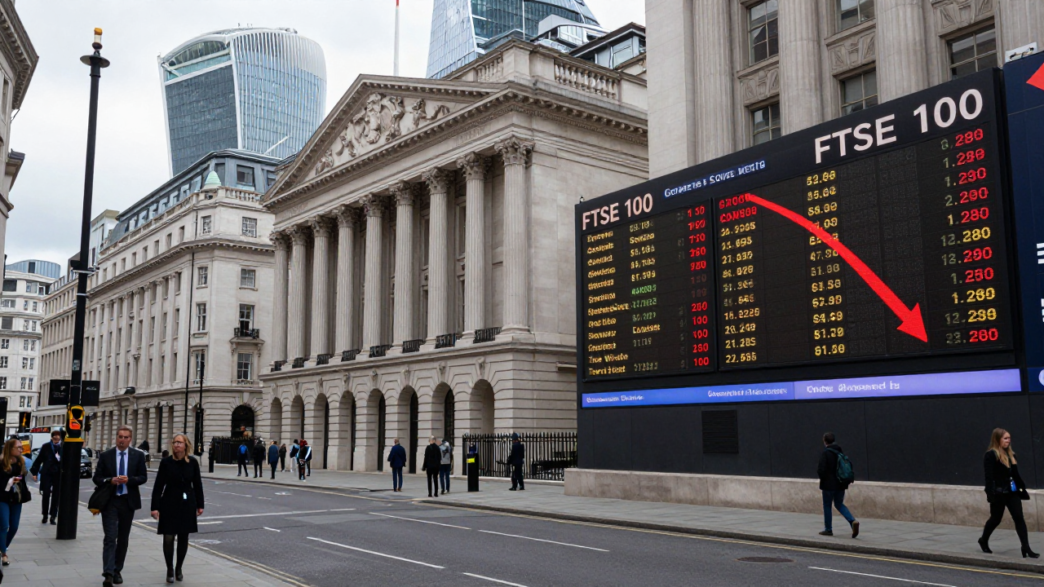
London’s FTSE 100 fell 0.8% to 10,458.5 points on Wednesday, October 7, after three consecutive sessions of gains, as banking shares led the retreat amid a renewed global bond selloff and elevated oil prices. The mid-cap FTSE 250 slipped 0.7% to a three-week low, according to Reuters.
The session’s pressures crossed markets: British long-term borrowing costs reached a 28-year high, while the equivalent U.S. yield rose to its highest level since 2002. Brent crude held near $101 a barrel as investors weighed increased Gulf exports against continuing Middle East supply risks and a storm approaching U.S. oil-producing regions.
The decline came as investors awaited the release of minutes from the Federal Reserve’s latest meeting for clues about U.S. monetary policy. In Britain, higher borrowing costs also sharpened attention on the government’s fiscal position ahead of Finance Minister John Healey’s first budget.
Banks weigh on the blue-chip index
Financial stocks were among the session’s biggest drags. HSBC, Standard Chartered and Barclays fell between 3.4% and 4.5%, Reuters reported, as the FTSE 100 moved lower. The declines came alongside a broader market reassessment as bond yields climbed internationally.
Higher yields can make government debt more attractive relative to shares and raise financing costs across the economy. But Wednesday’s market coverage did not attribute each bank’s share-price move to a single cause. Reuters also noted a Financial Times report that HSBC planned deep job cuts in its UK wealth business as part of a broader efficiency drive involving artificial intelligence.
Bond-market pressure spreads across countries
British 30-year government bond yields reached their highest level in 28 years, Reuters reported, against the backdrop of a wider selloff in government debt. The U.S. 30-year yield climbed to its highest level since 2002, adding to the global bond-market strain.
The move matters for the UK beyond daily trading: rising government borrowing costs can complicate fiscal decisions as the government prepares its budget. Reuters said the bond selloff could increase pressure on Healey ahead of that budget, though it did not report a new policy response from the finance minister on Wednesday.
In the United States, investors were watching for minutes from the Federal Reserve’s most recent policy meeting. The release was expected to provide further information about policymakers’ views on the economic outlook and the timing of any future interest-rate moves; the market report did not establish what the minutes would say.
Oil prices sustain risk concerns
Brent crude futures remained around $101 a barrel. Traders were weighing higher Gulf exports against persistent supply risks connected to the Middle East conflict, as well as a storm approaching U.S. oil-producing areas, according to Reuters.
Those competing factors left the immediate direction of supply uncertain. Elevated oil prices can also add to inflation concerns, a consideration for bond investors assessing the prospects for interest rates. The day’s reporting described those cross-market pressures but did not identify one as the sole driver of the FTSE’s decline.
Company developments offered a mixed picture
Oil major Shell said it expected third-quarter refining margins to reach a record $42 a barrel, up from $24 in the previous quarter. Its shares ended the session little changed, Reuters reported, despite the company’s outlook for stronger refining margins.
Pennon Group, a water utility, fell 20% and was the FTSE 250’s biggest decliner after it launched a fully underwritten £550 million rights issue and cut its dividend. The company-specific announcement coincided with the wider market retreat, but Pennon’s move was distinct from the FTSE 100’s decline.
What investors were watching next
The immediate scheduled event highlighted in reporting was the release of the Federal Reserve’s meeting minutes, which investors were monitoring for clues on U.S. policy. In Britain, the next major fiscal point identified was Healey’s first budget; Reuters did not give a date for it in its account of Wednesday’s trading.
The FTSE’s close captured a session in which higher yields and oil prices coincided with losses in financial shares, while individual company news produced divergent moves. Whether those pressures persist remained uncertain at the close: the available reporting documented the day’s market movements and upcoming events, but did not establish a lasting direction for yields, crude prices or equities.