

Updated:
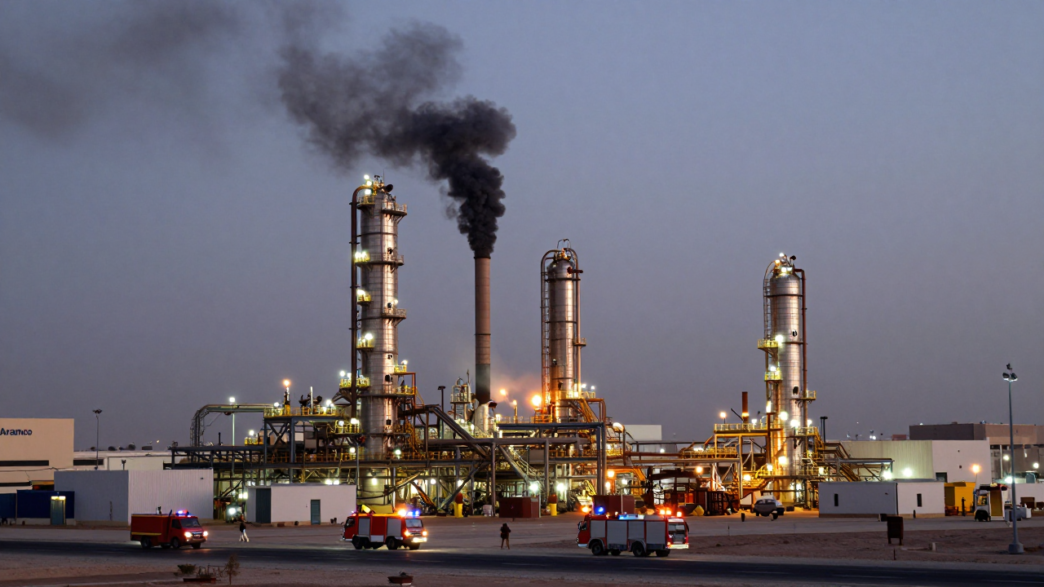
Yemen’s Houthi movement said it targeted a Saudi Aramco facility in Riyadh with ballistic missiles and drones on Saturday, October 3, as fighting with Saudi-backed Yemeni government forces intensified. A witness told Reuters that smoke and fire rose near an Aramco site in the Saudi capital, but Saudi authorities did not immediately confirm an attack and Aramco did not comment on the fire’s cause.
The claim adds a high-profile Saudi energy site to the conflict’s widening geography, but the available reporting does not establish that Houthi weapons caused the blaze or detail any damage, casualties or interruption to operations. The Houthis described the attack as retaliation for Saudi strikes in Yemen; that account, too, has not been independently established.
Fire seen near the facility, but cause remains unconfirmed
Reuters reported that a large plume of smoke and fire was visible in the vicinity of an Aramco facility in Riyadh on Saturday. Investing.com’s report said firefighters responded to the blaze. The reporting did not identify the specific facility or provide an assessment of damage to equipment or production.
Houthi military spokesman Yahya Saree claimed the group’s missiles and drones had targeted the site and said the operation was in response to Saudi attacks on Sanaa and other Yemeni provinces. Al Jazeera reported that Saree said the operation caused fires at the targeted site. These statements remain claims by a party to the conflict, rather than independent confirmation of the attack’s outcome.
Saudi Arabia and Aramco had not publicly confirmed that the facility was attacked in the initial reporting. Without an official account or an independently verified assessment, it remains unclear whether the observed fire was caused by an incoming weapon, whether the site sustained damage, or whether operations were affected.
Retaliation claims accompany widening air and ground battles
The Houthi claim came amid renewed exchanges between the movement and forces aligned with Yemen’s internationally recognized government, which Saudi Arabia supports. The Houthis said Saudi aircraft had carried out about 60 strikes over the previous 24 hours, including attacks on Houthi-controlled areas around Sanaa. Those figures were not independently verified in the reports reviewed.
Yemeni government forces said they had carried out strikes on Houthi targets in Sanaa and Saada. Government military spokesman Col. Majed Abdullah al-Nazili also reported 97 operations on fronts in Taiz and Lahij, claiming they targeted 260 Houthi fighters and damaged or destroyed military and supply vehicles. The reported casualty and battlefield figures could not be independently confirmed.
Fighting has also intensified around Taiz, where the Houthis have attacked government positions along a front reported to stretch about 15 kilometres. Investing.com, citing Al Jazeera, said shelling in the residential area of Dhubab killed a 14-day-old baby. The reports describe a conflict increasingly involving strikes far from the front lines as well as ground fighting in contested areas.
Earlier claims over Yanbu also drew no damage report
The Riyadh claim followed a Houthi announcement the previous week that the group had attacked Aramco facilities in Yanbu, a Red Sea port. Saudi Arabia said it intercepted six ballistic missiles fired toward Taif and the Yanbu area, but did not report damage to Aramco installations, according to Reuters.
The distinction between a claimed target and confirmed damage is important in assessing the potential effect on Saudi oil infrastructure. In both the Yanbu episode and the Riyadh fire, reports reviewed did not establish that Aramco production or exports had been disrupted. No operational impact from Saturday’s fire had been confirmed when the initial reports were published.
Escalation carries humanitarian consequences
The renewed combat is unfolding as civilians face worsening displacement and food insecurity. The United Nations World Food Programme said on October 2 that 74% of households in accessible government-held areas monitored by the agency could not meet their basic food needs, the highest level recorded there during the year. WFP said conflict had cut access to parts of Taiz and Hodeidah, leaving it and partners unable to reach about 350,000 people.
That humanitarian pressure is occurring alongside military claims that remain difficult to verify independently. The National reported that aid advocates feared further population movement could strain relief efforts, while WFP said fighting had disrupted markets and restricted humanitarian access. The available reporting does not establish a new ceasefire, a negotiated pause or a specific next diplomatic step.
For now, the confirmed development is that a fire was seen near an Aramco facility in Riyadh on October 3 and the Houthis claimed responsibility for an attack there. Whether the group’s missiles or drones caused the fire, how much damage occurred, and whether the episode will bring further attacks or a broader response remain unresolved in the reporting available as of October 4.