

Updated:
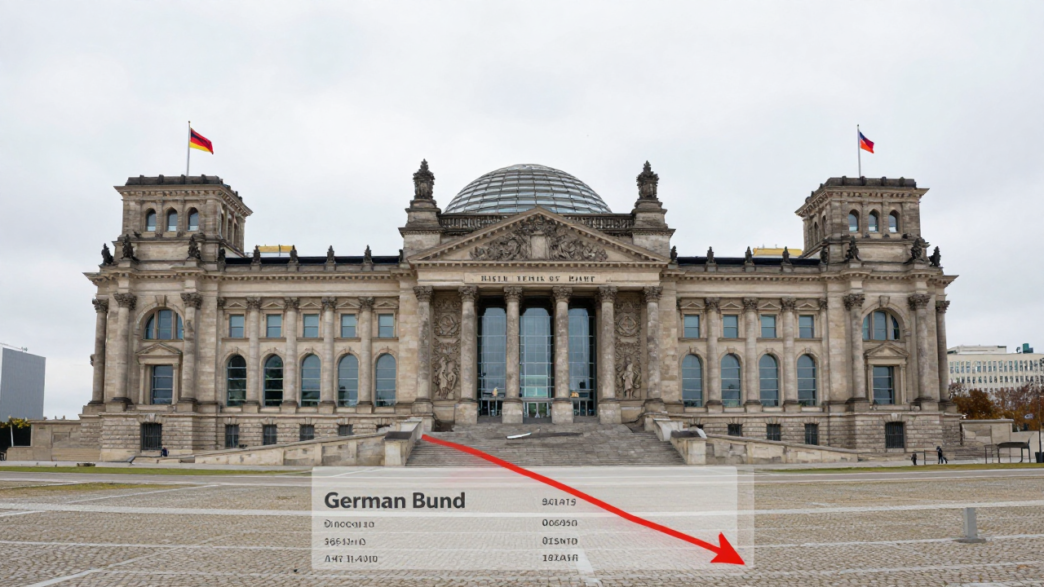
German government bond yields fell on Tuesday, October 6, as investors continued to favor Bunds over French sovereign debt amid concerns about France’s public finances and political outlook. Investing.com reported that Germany’s 10-year yield stood at 3.432%, while France’s 10-year OAT yield was largely unchanged at 4.776%.
The divergence kept the gap between French and German 10-year borrowing costs near 140 basis points, a sign that investors were demanding a substantially higher yield to hold French debt. The movement followed a volatile week in which French yields approached 5% and the spread briefly widened to its highest level since 2011, according to Reuters reporting from Monday.
Bunds attract demand as French yields stay elevated
Bond yields and prices move in opposite directions: when investors buy existing government bonds, their prices rise and yields fall. Germany’s Bund market is a key benchmark for euro-area government debt, while French OATs are priced at a premium to reflect the additional risk investors perceive in lending to France.
Investing.com said German yields declined across maturities, describing demand for German debt as a flight to quality. Its report put the 10-year German yield at 3.432%, compared with 4.776% for the French equivalent. Those figures imply a spread of about 134 basis points, close to the report’s description of a gap near 140 basis points.
Reuters’ account of Monday’s trading showed how unsettled the market had been: the French 10-year yield was around 4.883%, while Germany’s was about 3.432%. The French premium had exceeded 158 basis points on Friday before narrowing to roughly 145 basis points on Monday, according to Reuters. The differences between reported snapshots reflect changing market levels and timing.
France faces fiscal and political scrutiny
Investors’ concerns extend beyond the daily movements in yields. Reuters reported that French bonds had been under pressure amid high debt and political risks ahead of the 2027 presidential election. The broader sell-off in government debt has also coincided with worries about elevated energy prices, inflation and interest rates.
France’s 10-year borrowing cost came close to 5% the previous week, a level Reuters said had not been reached since the early 2000s. The widening gap with Germany matters because it captures the extra return markets require to lend to France rather than to Germany, and it can raise the cost of new borrowing for the French state if sustained.
Investing.com cited a projected French budget deficit of 5.4% of gross domestic product and public debt near 120% of GDP, alongside a proposed €54 billion fiscal consolidation package associated with Prime Minister Sébastien Lecornu. Those figures and the proposal were not independently corroborated in the available Reuters market reports, which described fiscal concerns more generally. The legislative path and implementation of any consolidation remain central uncertainties in the source reporting.
Recent volatility puts the moves in context
The latest session followed a sharp divergence late last week, when investors favored German and Dutch debt while French borrowing costs rose. Reuters reported that yields eased across several euro-area markets on Monday, but noted that the French-German spread remained historically wide after its Friday spike.
That distinction is important: lower yields in Germany do not necessarily mean French financing conditions are improving. If investors continue to buy Bunds while requiring high returns on OATs, the relative cost of French borrowing can stay elevated even as benchmark German yields fall.
ECB expectations and next steps
Market moves have also unfolded alongside shifting expectations for European Central Bank policy. Reuters reported on Monday that money markets had reduced expectations for another ECB rate increase this year and priced in a 22% chance of a hike at the October meeting. Such pricing is a market estimate, not an announced decision by the central bank.
The available reports did not identify a new French policy announcement or ECB intervention on October 6 as the cause of the day’s bond movements. Investors’ attention remains on the French budget outlook, political developments and whether the recent widening in borrowing costs persists; the reports did not specify a scheduled next event that would resolve those uncertainties.