

Updated:
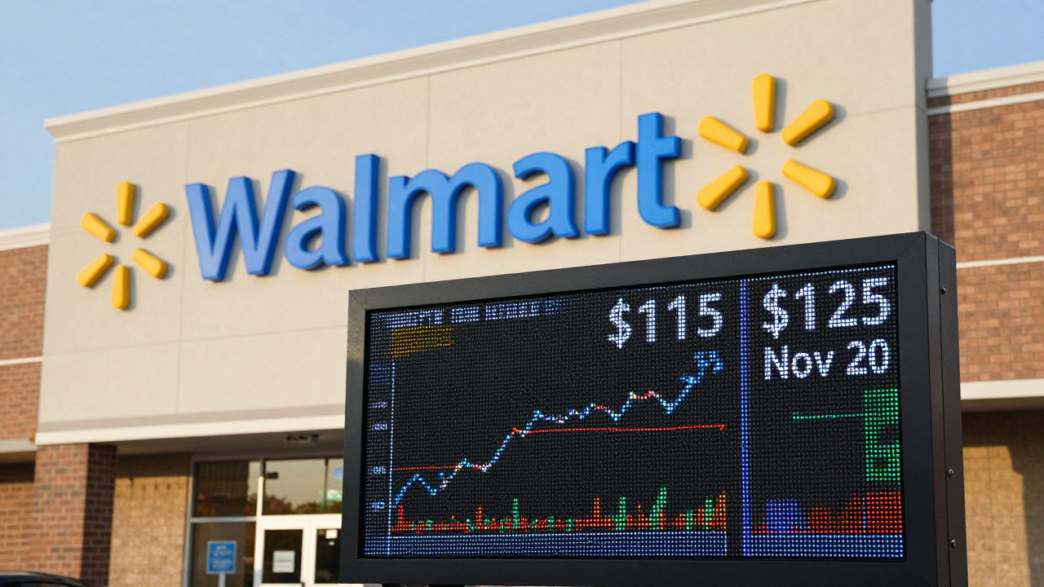
Walmart options trading was dominated by activity in November calls on Tuesday, October 6, with Investing.com reporting 216,428 contracts traded in the November 20 $115 and $125 call options by 12:21 p.m. New York time. The activity represented about three-quarters of the 286,500 Walmart options contracts recorded by that time, according to the report.
Walmart shares were quoted at $106.85, up 1.69%, in the same market-data feed. The two call strikes were therefore above the share price: $115 was about 7.6% higher, while $125 was roughly 17% higher. But the trading totals do not establish whether investors bought or sold the options, or whether the transactions formed one call spread.
Matched activity at two November strikes
The report said approximately 108,000 contracts traded at each strike, a closely matched pattern consistent with a $115/$125 spread. A conventional call spread could involve buying the lower-strike call and selling the higher-strike call, but the available data does not reveal the participants’ positions or the direction of either leg.
Volume at the two strikes was substantially greater than their previously reported open interest. The $115 call’s volume was about seven times its open interest of 14,561 contracts, while the $125 call’s volume was around 17 times its open interest of 6,500. That comparison suggests a large amount of activity relative to existing positions, but it does not by itself prove that the trades opened new positions; intraday volume and open-interest figures do not disclose each trader’s purpose.
If the structure was a bullish call spread, its holder would generally benefit from a rise in Walmart shares, with the spread’s value capped once the stock reached the upper strike at expiration. A position taking the opposite side would have a different payoff. Without execution details, premiums and the buyers’ or sellers’ identities, neither interpretation can be confirmed from the reported contract counts alone.
Calls outweighed puts in the reported session
Investing.com reported total options volume of 286,500 contracts at 12:21 p.m., including 269,529 calls and 16,971 puts—about 16 calls for every put. The sharp imbalance describes the session’s reported contract activity, not necessarily a consensus view: calls can be bought, sold or combined with other options, and volume totals do not identify whether traders expect a rise or are hedging other exposure.
Other call activity included 2,680 October 16 $110 calls, 2,551 October 16 $105 calls and 2,442 December 18 $120 calls. Each was much smaller than the reported November activity. The October contracts expire sooner than the November spread, but their volume alone does not clarify whether they represented directional bets, hedges or other strategies.
A separate 3,000-contract trade involving the November $115, $125 and $130 calls was also reported, with 750, 1,500 and 750 contracts at the respective strikes. Investing.com described it as possibly a butterfly or ratio structure; the exact construction and intent were not established by the figures provided.
Volatility readings changed little
The report put Walmart’s three-month implied volatility at 26.60%, down 0.02 percentage point, and said its 90/110 skew fell 0.18 percentage point to 1.49 percentage points. Those modest moves indicated little change in the cited volatility measures during the period covered by the article, despite the concentration of trading in the November calls.
Options volume and volatility readings answer different questions. A large number of contracts can change hands without a clear indication of net buying, while implied volatility reflects option prices rather than the direction traders expect the shares to move. The report’s data therefore does not establish that the market broadly priced in a sharp move toward either strike.
What the activity does—and does not—show
The November 20 expiration gives the contracts more time than the October 16 calls reported in the same session, but the available account does not provide the spread’s execution price, maximum potential return or loss, or confirmation that the matched legs were executed as a single order. Those details matter for understanding the economics of a position and cannot be inferred from strike prices and volume alone.
For now, the verifiable development is the concentration of reported Walmart options trading at the $115 and $125 November call strikes. The activity may be consistent with a spread, but whether it reflects an upside wager, a sale of upside, a hedge or another strategy remains unknown. The contracts are scheduled to expire on November 20, 2026; no subsequent position details or trader explanation were included in the reporting.