

Updated:
Asian equities broadly fell on Thursday, October 8, as renewed concerns over Middle East oil supplies pushed Brent crude above $102 a barrel and U.S. Treasury yields remained near their highest levels in decades. Samsung Electronics also slipped after forecasting record quarterly operating profit, with the preliminary figure narrowly below one major market estimate.
The declines followed a pullback on Wall Street on Wednesday that ended several days of gains for major U.S. indexes. The mix of higher energy costs and borrowing rates weighed on regional shares, while investors also assessed the Federal Reserve’s latest meeting minutes and a renewed period of trading in mainland China after its week-long holiday.
Losses spread across major Asian markets
Investing.com reported that South Korea’s KOSPI fell nearly 2% in early Thursday trading, with Samsung shares down more than 1%. Japan’s Nikkei 225 declined 1.1% and the broader TOPIX lost 1.4%. Hong Kong’s Hang Seng was down nearly 1%, while its technology sub-index fell about 2%.
Markets elsewhere also weakened. Australia’s S&P/ASX 200 fell 0.7%, India’s Nifty 50 lost 0.5%, and Singapore’s Straits Times Index dropped more than 3%, according to Investing.com. Mainland Chinese benchmarks edged lower as trading resumed after the National Day Golden Week holiday.
The Associated Press reported smaller declines in some indexes later in the session, including drops of 0.9% for Japan’s Nikkei, 0.8% for South Korea’s Kospi and 0.2% for Hong Kong’s Hang Seng. The different readings reflect market movements at different reporting times; the session remained broadly weak across the region.
Samsung’s forecast sets a new record but misses one estimate
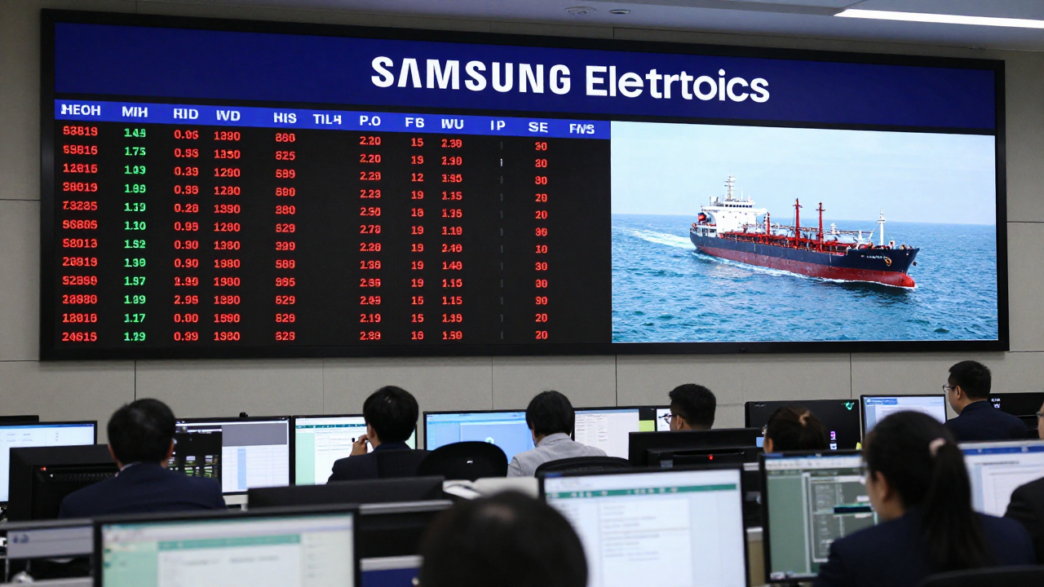
Samsung projected preliminary third-quarter operating profit of 107.4 trillion won, or about $80.1 billion, for the three months ended September 30. Investing.com reported that this was up nearly tenfold from 12.2 trillion won a year earlier and would be the company’s fourth consecutive quarter of record profit. Sales were preliminarily reported at 195 trillion won, more than double the year-earlier 86.06 trillion won.
The profit forecast came in below Bloomberg’s 108.67 trillion won estimate, though it was slightly above the 106.1 trillion won forecast cited from LSEG. That gap helps explain why the record headline did not translate into a share-price gain: investors were comparing the result with already elevated expectations as well as with the company’s past performance.
Strong demand for memory used in artificial-intelligence systems has been a major factor behind the jump in earnings, according to Investing.com. Samsung is among the suppliers of high-bandwidth memory used in AI computing, alongside SK Hynix and Micron. Samsung’s detailed third-quarter results are scheduled for October 29; the preliminary release does not provide the full breakdown of performance by business division.
Oil supply concerns add pressure
Brent crude rose more than 2% to above $102 a barrel in Thursday trading, while U.S. crude also advanced. Contemporary Investing.com reporting cited renewed attacks on commercial shipping in the Middle East, lower Strait of Hormuz vessel traffic and potential weather-related disruption to U.S. Gulf Coast supply. The AP likewise linked the oil rise to uncertainty over crude flows amid the continuing U.S.-Iran conflict.
Higher oil prices matter to markets partly because they can intensify inflation concerns and raise costs for energy-importing economies. In turn, expectations of persistent inflation can complicate the outlook for interest rates. The market moves alone do not establish how long the supply disruptions or price increases will last.
Treasury yields and Fed expectations remain in focus
The U.S. 10-year Treasury yield briefly reached 5.36% on Wednesday, its highest level since 2002, before easing after a strong Treasury auction. It stood near 5.31% in AP’s Thursday report. The yield’s rise has added to pressure on equities by lifting borrowing costs and making future corporate earnings less valuable when discounted against higher interest rates.
Minutes from the Federal Reserve’s latest meeting showed most policymakers viewed another rate increase by year-end as likely, while emphasizing that decisions would depend on incoming data. Investing.com reported that markets were pricing about a 19% chance of an October hike and roughly an 80% probability of a December increase. Those probabilities are market expectations, not a commitment by the Fed.
Wall Street’s pullback the previous day provided a further headwind for Asian trading. Investing.com said the Dow Jones Industrial Average and S&P 500 ended their four-session winning streaks, while the Nasdaq ended a five-day run. U.S. futures were little changed early Thursday, leaving investors without a clear signal of an immediate reversal in sentiment.