

Updated:
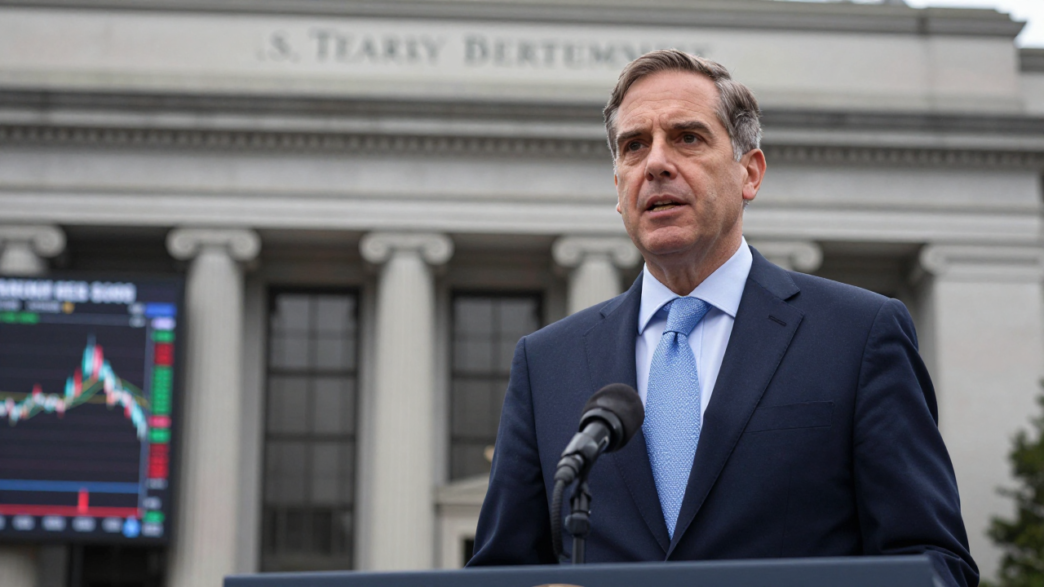
U.S. Treasury Secretary Scott Bessent said the recent rise in Treasury yields reflects a broader global increase in borrowing costs rather than a U.S.-specific warning sign, arguing that the move does not by itself warrant alarm. In an interview with Axios published Saturday, Oct. 3, he said he would be more concerned if investors were moving out of U.S. debt and into German or Japanese government bonds.
His assessment comes as long-term borrowing costs have climbed to levels last seen more than two decades ago. Higher yields can raise financing costs across the economy, including for households, businesses and the federal government, while also weighing on the value of existing bonds and other investments.
Bessent points to a broad repricing
Bessent’s argument rests on the rise in borrowing costs across major economies. He said the U.S. bond move should be viewed in that wider setting, rather than as evidence that investors are abandoning Treasuries in favor of other countries’ government debt. The remarks do not rule out domestic pressures, but frame the recent increase as part of a wider market shift.
The Treasury secretary also acknowledged limits on the government’s influence over market yields. According to the report, he said Treasury could not dictate where bond yields trade, while suggesting policymakers could encourage investors to look beyond short-term market movements and consider the wider economic picture.
Yields reached multi-decade highs
Recent trading has shown how quickly borrowing costs can move. The 10-year Treasury yield approached 5.34% on Thursday, Oct. 1, its highest level since 2002, before retreating later in the session. The Associated Press reported it ended that day at 5.23%, down from 5.29% late Wednesday, but still well above levels below 5% the prior week.
The 30-year mortgage rate, which tends to track the 10-year Treasury, climbed to 7.28% from 7.03% a week earlier, according to Freddie Mac data cited by Axios on Oct. 2. That illustrates how a bond-market repricing can reach beyond government financing: longer-term Treasury yields help shape borrowing rates for mortgages and other credit.
Yields rise when bond prices fall. When investors demand more compensation to hold longer-dated debt, governments and other borrowers can face higher costs, while households and businesses may see financing become less affordable.
Inflation, borrowing and market mechanics
The reports identify several forces behind the selloff, rather than a single cause. Persistent inflation concerns, elevated energy prices linked to the U.S.-Iran conflict, large government borrowing needs and a resilient U.S. economy have all contributed to upward pressure on yields. The demand for capital to fund artificial-intelligence infrastructure has also drawn attention as major technology companies turn to debt markets for investment financing.
Axios reported that market plumbing may be amplifying the move. Institutional investors that normally buy government debt have instead been selling, while investors in mortgage-backed securities may adjust their hedges when rates rise quickly, adding to Treasury sales. Axios said some observers also suspect hedge funds may be unwinding the so-called basis trade, but noted that evidence for this explanation was not yet clear.
The distinction matters because technical selling can intensify a move already driven by economic or fiscal concerns. Axios reported that foreign governments have pulled back from Treasury buying over recent years, leaving private investors with a larger role in the market. Its report described the resulting supply-demand picture as difficult to assess in real time.
AI spending and yen support also discussed
Bessent also rejected the view that rapid AI investment necessarily amounts to a speculative bubble, according to Investing.com’s account of the Axios interview. He pointed to Microsoft, Alphabet’s Google and Meta Platforms, arguing their spending is backed by substantial revenues and continuing business growth. The reporting did not provide a detailed breakdown of the companies’ debt issuance or quantify how much AI financing contributed to the broader rise in yields.
The interview also touched on U.S. involvement in efforts to support Japan’s currency. Investing.com reported that Washington and Tokyo had coordinated in foreign-exchange markets, including a joint intervention aimed at supporting the yen. The account offered no additional details on the timing or scale of that action.
What remains uncertain
Bessent’s comments provide the administration’s interpretation of the market move, not a guarantee that yields will fall or remain stable. Recent reporting identifies both broad forces—such as inflation and borrowing needs—and market-specific dynamics as contributors, leaving uncertainty about how much weight to assign to each factor.
Investors will continue to weigh incoming economic data, energy prices, government financing and the behavior of large bond-market participants. No specific next policy step or timetable was announced in the reports of Bessent’s remarks, and the Treasury secretary’s statement that the department cannot set market yields underscores that bond prices remain determined by trading in the market.