

Updated:
Renault Group plans to invest more than €10 billion in France over the next five years, directing the money toward electric vehicles and more affordable cars, Chief Executive François Provost said on Saturday, October 3. He made the announcement in an interview with French radio station France Inter, according to Reuters.
Provost said the proposed spending depends on France’s social and political conditions. Renault has not published a detailed breakdown of the new investment or identified specific projects, factories or vehicle models that would receive funding. The announcement signals the company’s intention to continue expanding its French industrial base as it pursues electrification and lower-priced vehicles.
Provost ties the plan to political and social conditions
The CEO said Renault would reinvest more than €10 billion in France over the coming five years, but attached a qualification: the plan would proceed if the country’s social and political context allowed it. His comments did not specify what conditions Renault considers necessary, or whether the proposed amount is a firm, approved capital budget.
The investment would follow €13 billion that Renault says it has put into transforming its French industrial operations since 2021. In a July 2026 company statement, Renault said that earlier spending was intended to build out the electric-vehicle value chain across its French sites. The new figure should not be confused with the €13 billion commitment the company has separately described as an additional France investment by 2030 under its futuREady strategy.
Renault’s public materials have not reconciled that previously stated €13 billion plan with Provost’s Saturday remarks about spending more than €10 billion over five years. The company has not said whether the new figure is a revised target, a subset of the longer-term commitment, or a distinct investment plan.
French output target rises by at least a quarter
Renault also expects to build at least 25% more vehicles in France in 2026 than in 2025, Provost said. He put French production at 500,000 vehicles last year, which implies a minimum output target of 625,000 this year if the stated increase is achieved.
The executive attributed the expected rise to growing electric-vehicle activity. Reuters reported that the Renault 5, an electric model made in Douai, is among the company’s best-selling electric cars. Renault has not provided a plant-by-plant production forecast or a detailed split between electric and other vehicles for the 2026 target.
The production goal provides an immediate operational measure alongside the longer-term investment pledge. However, it remains a forecast: Renault did not specify how much of the increase depends on individual models, shifts, staffing or supplier capacity.
Investment builds on a nationwide industrial network
Renault’s French electric-vehicle operations extend beyond the Douai assembly plant. The company said in July that its factories in Douai, Maubeuge, Dieppe, Batilly and Sandouville, along with mechanical sites in Cléon, Ruitz and Le Mans and its Flins Refactory, are involved in its electric transition.
Renault reported that it had produced more than one million electric vehicles in France since 2010, with 600,000 made at its northern France industrial hub, known as ElectriCity. The group also said it employs nearly 39,000 people in France and supports about 35,000 indirect jobs in its supplier network. Those figures are company-reported and describe the scale of the existing industrial base, not new jobs promised under the latest investment announcement.
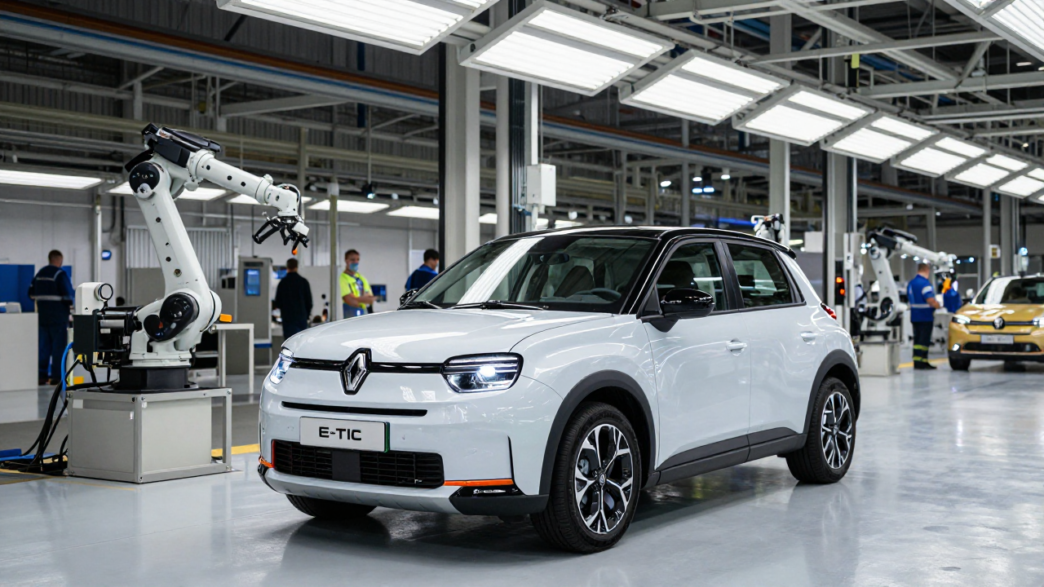
In its July update, Renault cited the Renault 5 E-Tech as a flagship of the Douai production ramp-up and said 100,000 units had been produced by the end of 2025. The company said the site was on track to exceed 200,000 Renault 5 units during 2026; it has not said whether that model-specific milestone is part of the Saturday investment plan.
Affordability and execution details remain open
Provost linked the proposed spending not only to electric vehicles but also to making cars more affordable. That emphasis comes as Renault’s stated strategy combines electrification with a focus on competitiveness and cost efficiency. The company’s March 2026 futuREady plan set out a broader direction for its brands, but the Saturday announcement did not identify a target price, vehicle launch or cost-reduction commitment for the more affordable cars.
Renault’s own July statement said it planned to invest a further €13 billion in France as part of its mid-term plan, provided the right conditions were in place. Its current corporate overview describes that as additional investment by 2030, while Provost’s new remarks set a five-year horizon and a lower minimum amount. Without a project list or clarification from the company, how the commitments relate remains uncertain.
No detailed timetable for approving or deploying the more-than-€10-billion sum was announced. Renault has also not specified how the spending will be divided among vehicle development, production equipment, batteries, suppliers or other facilities. The next concrete indicators will be whether the group publishes a more detailed investment schedule and whether it achieves the 2026 French production increase it forecast.